Vaar in Panchang: Complete 7-Day Property & Remedies Guide
Discover how Vaar—the solar weekday limb of the Hindu Panchang—shapes Vastu Shastra and property decisions. Compare all seven days from Ravivaar to Shanivaar for housewarming, construction milestones, and directional balance.
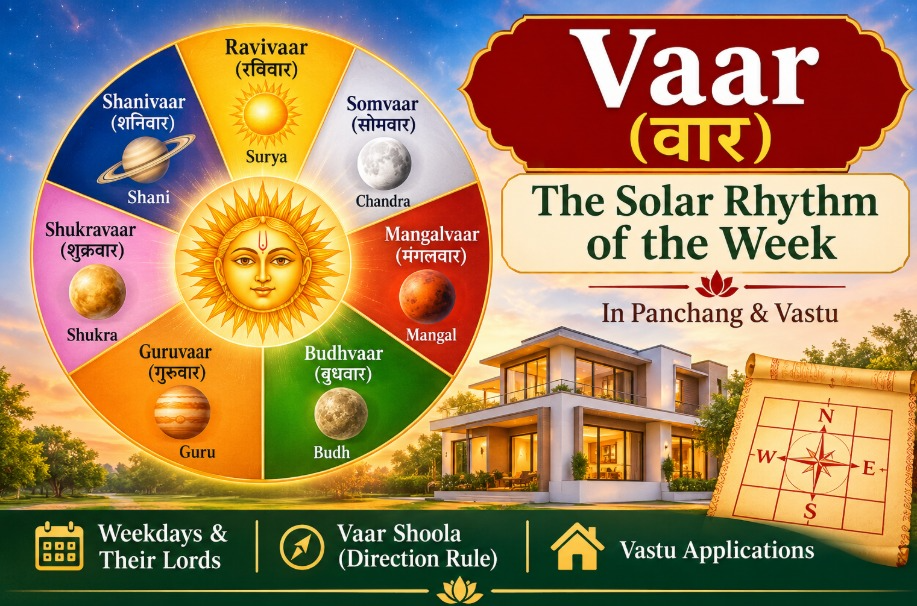
Rooted in ancient Vedic astronomy (Jyotish), Panchang (literally Panch = five, Anga = limbs) is the traditional Hindu almanac used to map time and identify auspicious muhurta for life, spiritual rituals, and Vastu milestones. Unlike a standard Gregorian calendar that tracks solar dates, a Panchang measures the shifting alignment of the Sun, Moon and stars across five core constituents:
Vaar (Weekday): The seven-day weekly cycle, with each Vaar traditionally beginning at local sunrise and continuing until the next sunrise.
Tithi (Lunar Day): The 30 phases of the lunar month, calculated from each 12-degree angular separation between the Sun and the Moon.
Nakshatra (Lunar Mansion): The 27 star constellations along the ecliptic through which the Moon travels daily, shaping the subtle quality of an action.
Yoga (Luni-Solar Alignment): The 27 auspicious and inauspicious combinations derived from adding the longitudes of the Sun and the Moon.
Karan (Half-Tithi): Half of a lunar day (6 degrees of Sun-Moon separation), governing the immediate momentum and completion of tasks.
Vaar: The Solar Rhythm of the Week
Among the five limbs of the Panchang, Vaar is the most direct and accessible anchor of daily life. While Tithi and Nakshatra shift continuously based on lunar motion, Vaar follows the steady rhythm of Suryoday (sunrise)—beginning at local sunrise and lasting until the following sunrise.

Each of the seven Vaars is governed by a presiding planetary lord (Vaaresh)—from Surya on Ravivaar (Sunday) to Shani on Shanivaar (Saturday). In Panchang and Vastu Shastra, this planetary rulership infuses every day with a distinct Tatva (element), Sangya (temperament—such as fixed, movable, soft, or fierce), and Vastu Disha (directional resonance). By aligning everyday actions—such as laying foundations, moving into a new home (Griha Pravesh), balancing directional zones, or avoiding travel in the Vaar Shoola direction—with the presiding Vaar, you harmonize your living space with the natural movement of the cosmos.
Quick Vastu & Property Decision Matrix as per Vaar
(Read together with Nakshatra, Tithi and overall Muhurt)
Recommended Days for Griha Pravesh (Housewarming):
Somvaar (Monday)
Budhvaar (Wednesday)
Guruvaar (Thursday)
Shukravaar (Friday)
Recommended Day for Foundations (Shilanyas) & Main Pillars:
Ravivaar (Sunday).
Recommended Day for Plot Inspection & Boundary Walls:
Mangalvaar (Tuesday) — governed by Bhumiputra (Mars).
Recommended Day for Deep Cleaning, Repairs & Decluttering:
Shanivaar (Saturday) — governed by Shani (discipline and structural upkeep).
Weekly Vastu & Property Dos and Don'ts by Vaar
(Read together with Nakshatra, Tithi and overall Muhurt)
Vaar | What to Do | What to Avoid |
Ravivaar (Sunday) | Laying Foundations (Shilanyas) & Main Pillars Energizing the Purva Disha, Sunlight cleansing & Havan Government approvals | Routine Griha Pravesh (housewarming) Residential sale deeds Paschim Disha travel as per Vaar Shoola |
Somvaar (Monday) | Griha Pravesh (Housewarming) Water installations (tanks, borewells, purifiers) Vayavya Kon airing | Heavy permanent foundations (Shilanyas) due to Chara (movable) energy Purva Disha travel as per Vaar Shool |
Mangalvaar (Tuesday) | Plot Inspection & Boundary Walls (governed by Bhumiputra Mars) Agneya Kon kitchen/fire setup Dakshin Disha stabilization | Griha Pravesh or peaceful celebrations (Ugra/Krura temperament) Uttar Disha travel as per Vaar Shoola Taking new loans |
Budhvaar (Wednesday) | Griha Pravesh & Commercial Openings (Saumya & Prithvi energy) Setting up home offices, study desks, cash lockers Uttar Disha indoor plants | Uttar Disha travel as per Vaar Shoola Letting indoor plants wilt Making impulsive financial deals |
Guruvaar (Thursday) | Griha Pravesh, Property Registration & Pooja Ghar Setup Sanctifying the Ishanya Kon Bringing sacred texts in home | Dakshin Disha travel as per Vaar Shoola Cluttering the Ishanya Kon Washing hair, cutting nails, or harsh floor-scrubbing |
Shukravaar (Friday) | Griha Pravesh & Interior Decor/Aesthetics (Mridu soft energy) Hanging artwork, mirrors, lighting Balancing the Agneya Kon | Paschim Disha travel as per Vaar Shoola Leaving spaces dim, cluttered, or unwashed overnight |
Shanivaar (Saturday) | Deep Cleaning, Decluttering & Structural Repairs Installing iron gates/grills, sea-salt floor mopping Paschim Disha upkeep | Routine Griha Pravesh (Daruna/Krura energy) Purva Disha travel as per Vaar Shoola Buying iron, mustard oil, or salt for home storage |
Conclusion: Aligning Daily Rhythms with Sacred Space
Understanding Vaar transforms an ordinary weekly calendar into a practical compass for Vastu Shastra and mindful living. Each day—from the foundational strength of Ravivaar and the nurturing flow of Somvaar to the disciplined order of Shanivaar—carries a distinct planetary pulse that either supports or resists specific home and property actions.
While Vaar sets the foundational solar tone of the day, Jyotish and Vastu always evaluate it alongside Tithi, Nakshatra, Yoga, and Karan (Panchang Shuddhi) before finalizing major milestones like Shilanyas or Griha Pravesh. By respecting daily Vaar Shoola boundaries, energizing the corresponding Vastu direction, and performing simple planetary remedies, you bring lasting harmony, clarity, and prosperity into your home.