Does Vastu Apply to Wine Shops? Why Crowded Businesses Don't Tell the Whole Story.
Why are wine shops crowded even when their premises appear to have Vastu defects? Is customer footfall the only measure of commercial Vastu? This article explores the distinction between business performance and the overall well-being of business owners and employees, highlighting why commercial Vastu must be evaluated beyond sales and customer movement.
Does Vastu Apply to Wine Shops? Why Crowded Businesses Don't Tell the Whole Story.
One question that frequently comes up during Vastu discussions is:
"If Vastu is so important for business success, why are wine shops crowded irrespective of their location or apparent Vastu defects? Does Vastu not apply to liquor shops?"
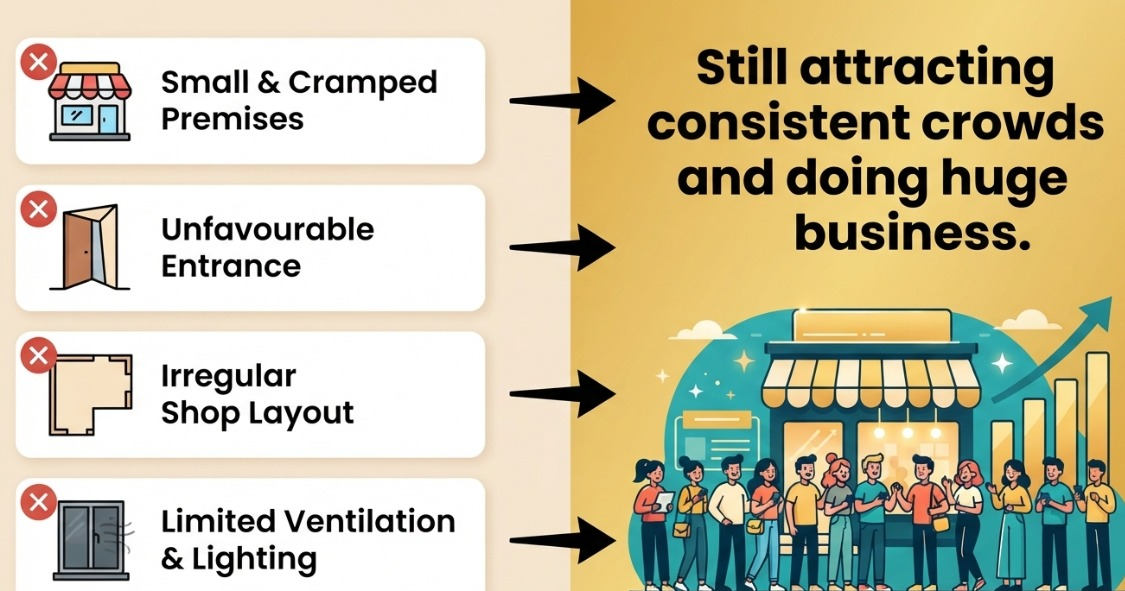
Some people even use such examples to question the relevance of Vastu altogether.
However,
Are we judging only the crowds
OR
Also the commercial performance of the establishment
the well-being of its owner
the working environment of its employees
the overall experience of everyone associated with the premises
1) Why are Wine Shops almost always crowded?
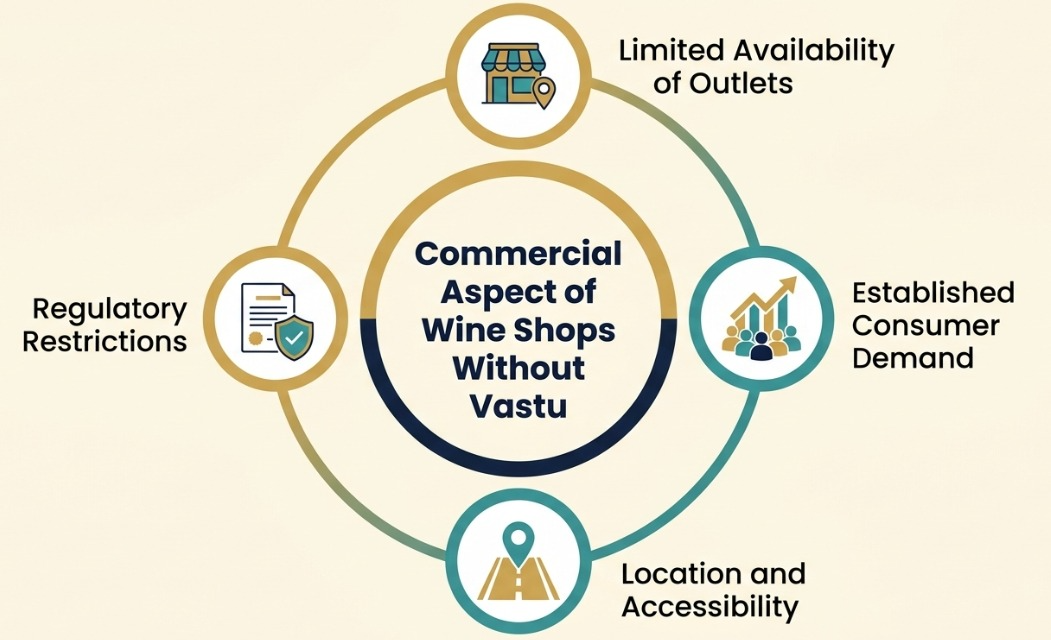
Customer footfall is influenced by the availability of licensed outlets, consumer demand and location convenience. None of these factors, by themselves, establishes the quality of Vastu of the premises.
Limited availability of outlets: Customers therefore have fewer alternatives, which can concentrate demand at the available outlets.
Established consumer demand: Liquor is an established consumer product with an existing market. Retailers do not necessarily have to create demand for an entirely new product.
Location and accessibility: Customers generally prefer outlets that are conveniently located and easily accessible. A strategically situated shop may therefore enjoy consistent footfall.
Regulatory restrictions: Licensing conditions, permitted operating hours and other regulations influence the availability and distribution of liquor retail outlets.
These factors can contribute to consistent customer movement, even when the premises do not appear particularly impressive or well-planned.
Therefore, a crowded wine shop is not, by itself, evidence of excellent Vastu. It may simply be operating in a favourable commercial environment.
2) Are we measuring Vastu correctly?
When someone points towards a crowded wine shop and questions its Vastu, the underlying assumption is usually that good Vastu should result in more customers and better business.
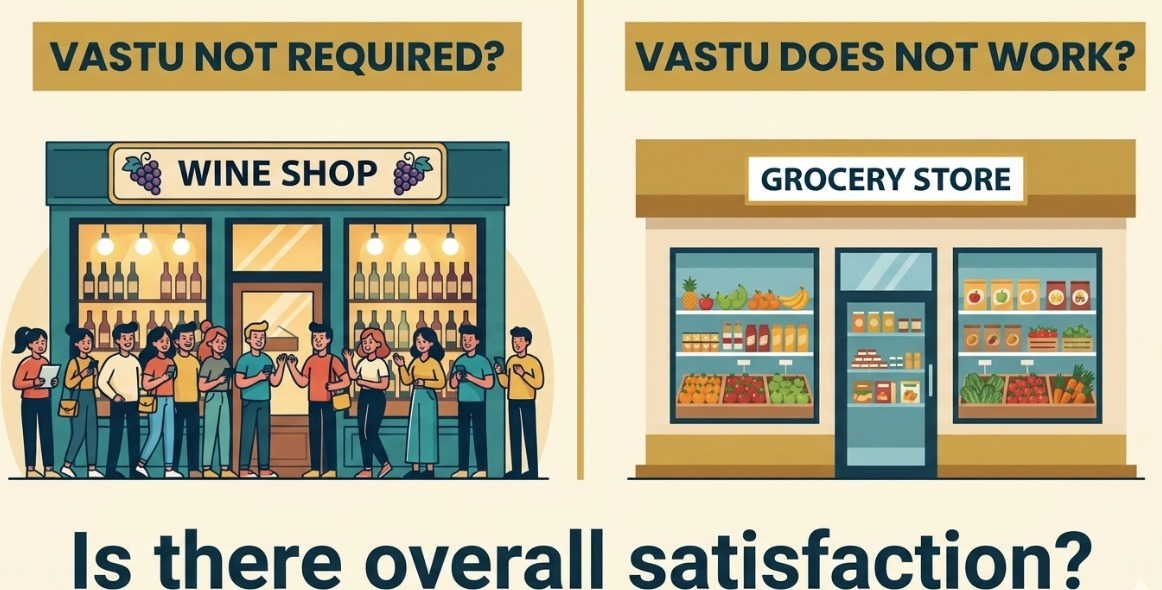
A commercial establishment is not merely a place where buying and selling take place. It is also a workplace, an investment, a source of livelihood and, in many cases, a significant part of the owner's life.
The business generates revenue, but the premises are also occupied by people whose health, relationships, professional growth and personal well-being matter.
If we evaluate a commercial property only by the number of customers entering it, we are overlooking several important dimensions.
Consider the following:
Is the owner financially secure, or is the business generating high turnover without corresponding wealth creation?
Is the owner enjoying good health and peace of mind?
Are family relationships harmonious?
Does the owner have a healthy professional and social network?
Are employees comfortable, stable and satisfied with their working environment?
Does the business offer long-term stability and opportunities for growth?
These questions may not be visible to a person standing outside the shop. Yet, they are relevant when we consider the people associated with the premises.
A crowded establishment may be commercially active without necessarily representing overall well-being for everyone connected with it.
3) A Business may flourish even when its owner does not
Business performance and personal well-being are two different measures of success.
Imagine a wine shop that attracts a large number of customers every day. Its sales figures may look impressive, and the business may appear to be doing exceptionally well.
However, consider a few possibilities:
The owner may be facing continuous financial pressure despite substantial turnover.
The business may be generating revenue but failing to create long-term financial security.
The owner may be experiencing strained family relationships or a lack of personal time.
The owner may have difficulties maintaining professional relationships and partnerships.
The business may be dependent on the owner's constant involvement, leaving little room for personal growth or stability.
Would we still describe the establishment as an example of complete success merely because it attracts customers?
Similarly, an establishment with relatively modest footfall may provide its owner with stable earnings, financial security, a manageable workload and a healthy personal life.
Which of these two establishments would we consider more successful?
The success of an enterprise and the well-being of the person running it are not necessarily the same thing.
4) Vastu is also about the People occupying the Space
A common mistake in commercial Vastu assessments is to focus almost entirely on the nature of the business.
For example, when assessing a retail establishment, attention is often directed towards the entrance, customer movement, cash counter, storage and sales area.
These are important considerations. However, they do not represent the entire picture.
A commercial property has different stakeholders, each with a different relationship with the premises.
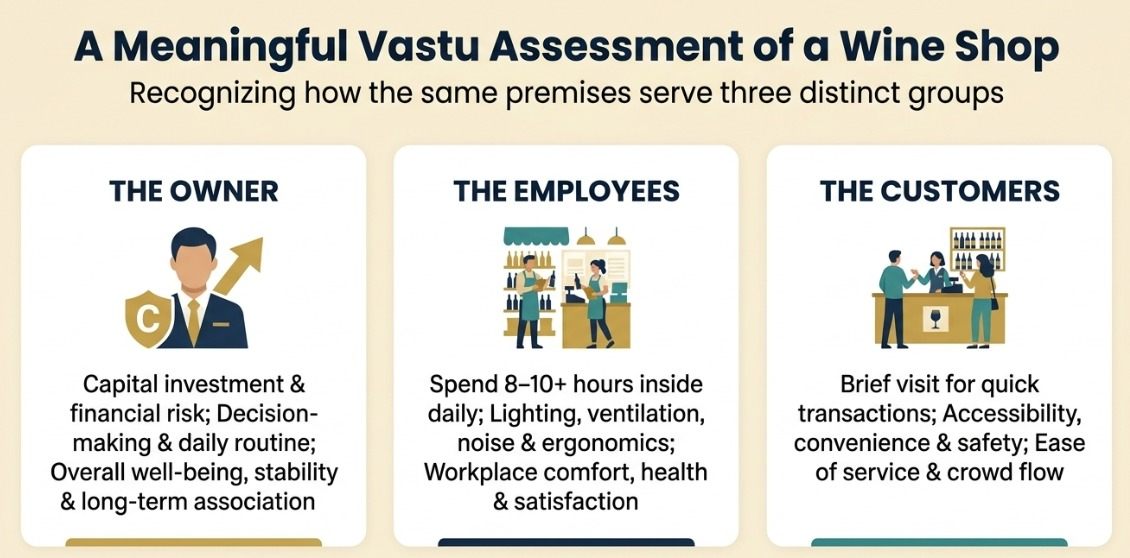
5) How should we actually evaluate the Vastu of a Wine Shop?
Let us return to our original question.
Does Vastu apply to wine shops?
Absolutely. But the assessment should not be limited to whether the shop attracts customers or generates revenue.
A wine shop, like any other commercial establishment, should be examined in the context of its actual use and the people associated with it.
A comprehensive assessment may consider:
The overall orientation, shape and spatial organisation of the premises.
The assessment of natural light, ventilation and circulation
The location and functionality of the entrance.
The distribution of different activities within the available space.
The arrangement of storage, billing and operational areas.
The working environment of employees.
The owner's workspace and involvement in daily operations.
The relationship between the built space and its occupants.
The suitability of the premises for its intended commercial activity.
The directional arrangement of the property should also be considered as part of the Vastu assessment.
We should also remember that Vastu is not a substitute for sound business decisions, professional management, financial planning or regulatory compliance. Nor should every health, financial or relationship difficulty be attributed to a Vastu defect.
Conclusion: Look Beyond the Cash Register

We cannot conclude that the premises has excellent Vastu simply by observing the number of customers.
Equally, we cannot conclude that the premises have poor Vastu merely because the owner or employees experience difficulties.
There are numerous factors that influence human life and business outcomes.
The point is not to find a Vastu explanation for every success or failure. It is to understand that commercial footfall is only one part of a much larger picture.
A commercial establishment is not just a revenue-generating unit. It is a space where people invest their money, spend their time, develop relationships, make decisions and build their livelihoods.
When evaluating the Vastu of a commercial establishment, we should not merely ask how much business the premises generate. We should also ask what kind of environment the premises create for the people who own, manage and work there.