Best Sleeping Position as per Vastu
South and East are the most favourable directions for sleeping, promoting longevity, stability, wisdom and knowledge while sleeping with the head towards West is considered less favourable. Sleeping with head in North should be avoided.
In Vastu Shastra, the direction of the head while sleeping is one of the most important factors affecting mental stress and physical health.
Orientations and preferences are as below:
1st preference - Head towards South and Feet towards North.
2nd preference - Head towards East and Feet towards West.
3rd preference - Head towards West and Feet towards East.
4th preference - Head towards North and Feet towards South. (Avoid)
1) Comparison
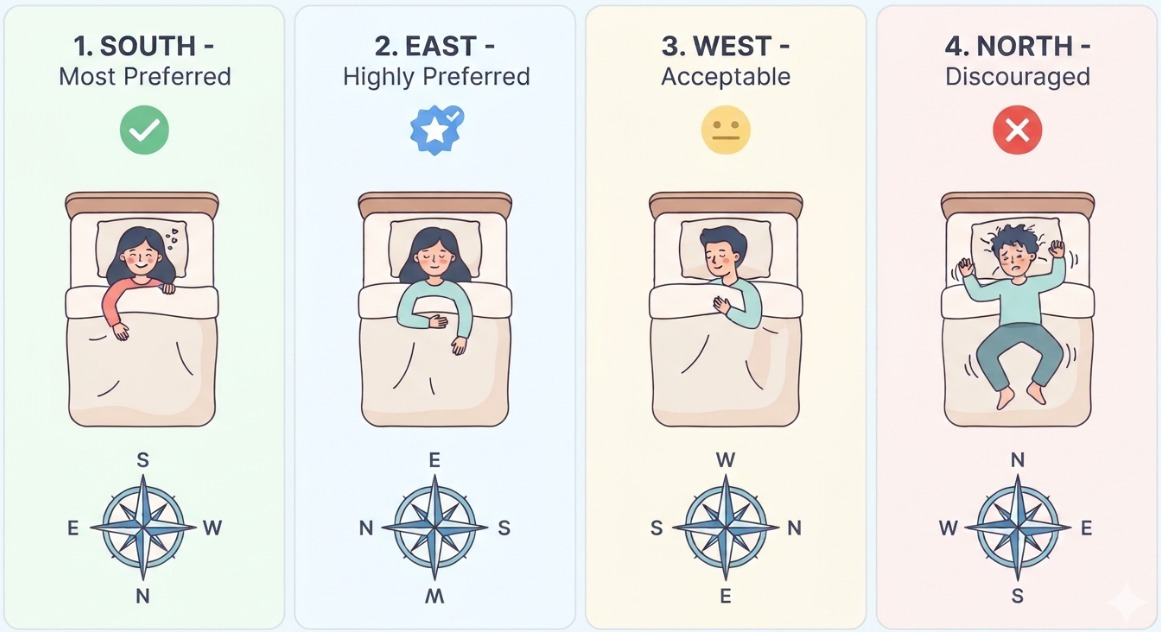
Head in South (Best) ★★★★★
Promotes deep sleep, good health, mental clarity, and wealth. Ideal for everyone.
Head in East (Second Best) ★★★★
Boosts memory, concentration, and spiritual growth. Ideal for students, teachers, and researchers.
Head in West (Acceptable) ★★★
Brings moderate or mixed results, though it may occasionally cause restless sleep. Suitable for businesspersons, ambition, and career stability.
Head in North (Avoid) ★
Causes magnetic repulsion, blood circulation issues, restlessness, and insomnia. Avoidable for everyone.
2) Reason
(A) Earth's poles and human body
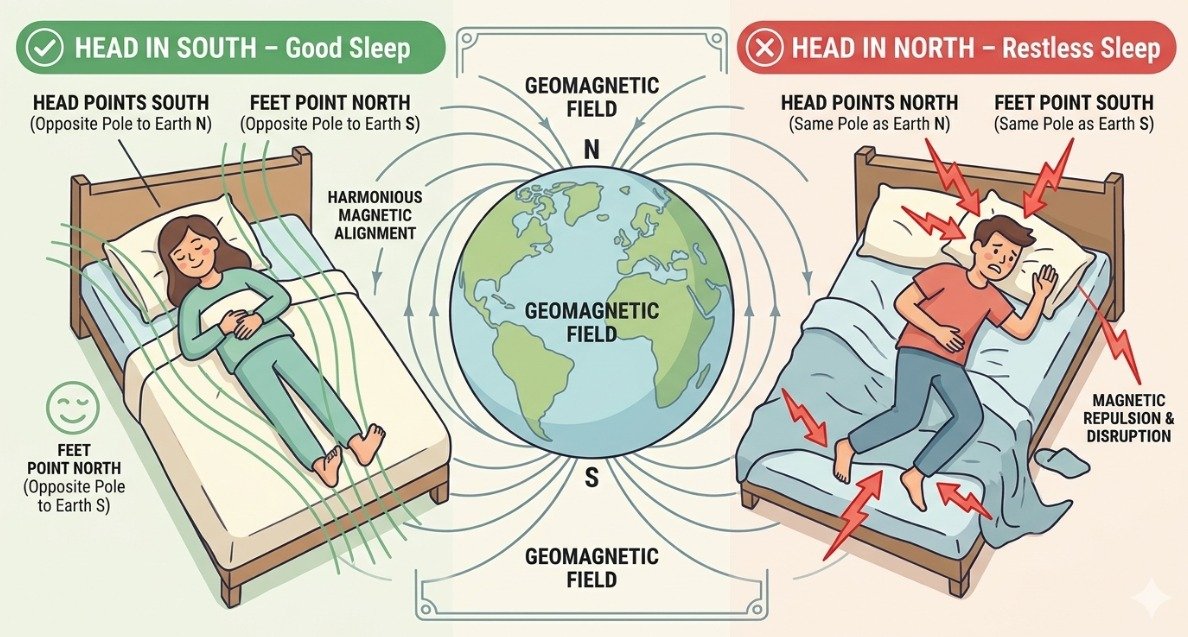
Our planet Earth is has 2 magentic poles, North and South, and itself operates as a giant magnet. Spending 6 to 8 hours everyday on bed in the same position results in human body consttantly interacting with this magnet. Further, the human brain too produces electromagnetic waves, albeit in miniscule quantity.
Magnetic field lines flow outward from the North pole and toward the South pole. In a human body, head represents the North while feet represent the South. When two North poles face each other, the field lines push against and deflect each other instead of connecting, creating a high-pressure zone of magnetic energy between them
Thus, keeping your head in North, may result in magnetic repulsion, resulting in headaches over time. However, keeping your head in South creates an instant conection between opposite poles, resulting in a smooth flow of electromagnetic currents. Thus, body becomes relaxed.
(B) Sun's position and human body
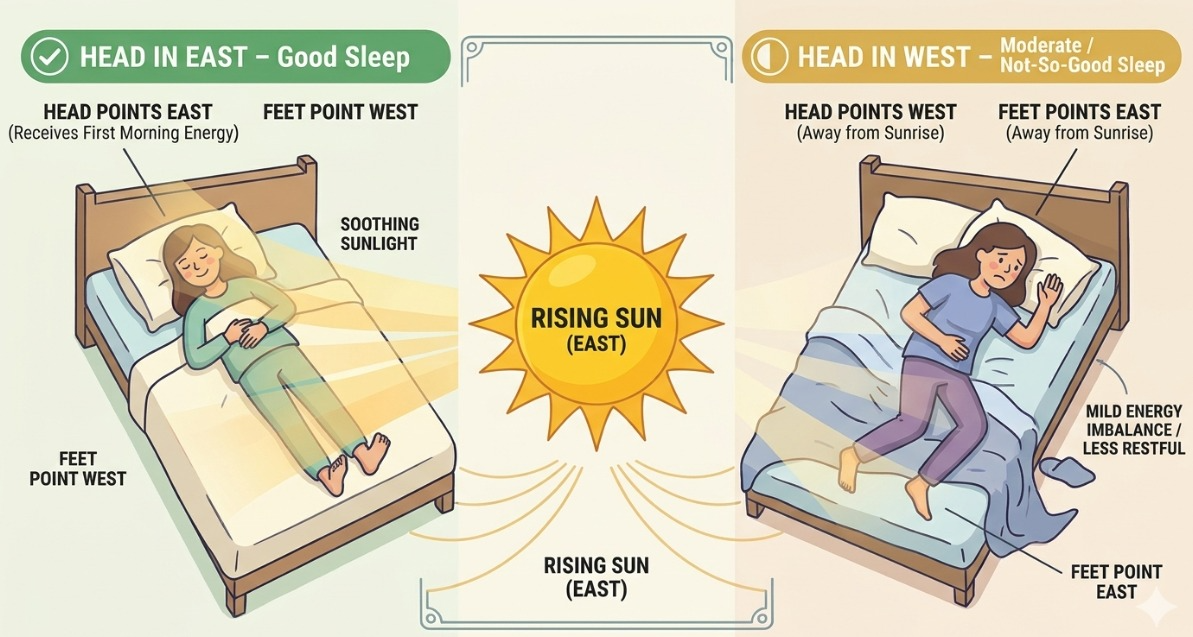
Sun rises in the East. Our body naturally reacts to sunrise, i.e. we wake up without alarm clocks once the sun rises in the morning. Sleeping with head to the East results in body aligning with the movement of the sun. Over time, this may result in attentiveness, and increase in productivity.
3) Quick Vastu Tips for a good night's sleep
Bed Placement: Place your bed against a solid wall, ideally in the Southwest or South part of the room.
Heaviness: Keep heavy articles in the Southwest of bedroom
Avoid Beams: Do not sleep directly under a ceiling beam, as it can restrict energy flow.
Mirrors: Ensure no mirror reflects your body while you are lying in bed.
Electronics: Keep gadgets, phones, and TVs away from the bed to maintain a calm environment.
Inside the bed: Do not keep very heavy articles, iron products, inside the bed storage. Avoid clutter.
Bed frame: Wood works best. Avoid plastic and Iron for making bed structure.
4) Direction of Bedroom is different from Direction of Bed
The direction in which the bedroom is located and the direction in which the head points while sleeping are two separate Vastu considerations.
E.g. A bedroom in the South-West does not automatically mean that the head must point towards South-West. The placement of the bedroom and the orientation of the bed need to be examined independently.