Kitchen in East (Purva Disha): Vastu Effects and Remedies Without Demolition
A kitchen in the East (Purva Disha) needs to be assessed according to its exact location within the Vastu Purusha Mandala. While the South-East is commonly preferred for cooking, the Mānasāra mentions the Parjanya quarter as a possible kitchen location. Explore the traditional significance, possible advantages and concerns, and practical ways to improve an East-side kitchen without demolition.
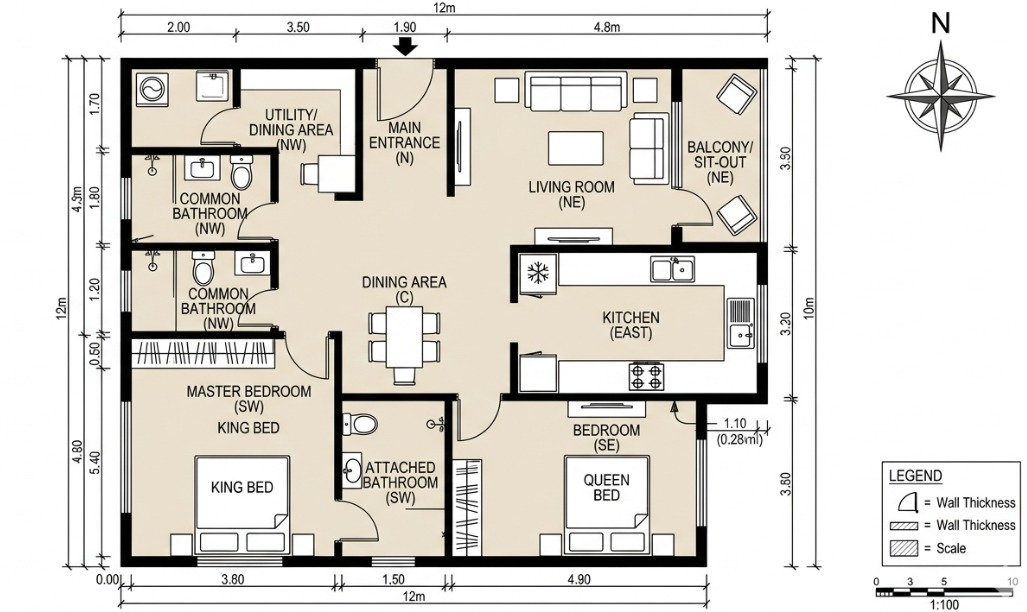
The East direction (Purva Disha), traditionally associated with the rising Sun, is regarded as an important zone in Vastu Shastra. It represents the beginning of the day, light, vitality and new opportunities and beginnings. Since the East receives the morning sunlight. This makes it an important direction in traditional architectural planning, particularly for daylight and the natural illumination of living spaces.
While the South-East (Agneya Kon) is commonly recommended for the kitchen because of its association with Agni devta, an East-side kitchen requires a more detailed assessment rather than an automatic negative judgement.
Though kitchen in the East is not viewed negatively generally, its extent and its internal arrangement are important considerations. The precise pada occupied by the kitchen matters. A kitchen located in the Parjanya pada cannot automatically be assessed in the same way as one extending across several eastern padas.
But what happens when the kitchen is located in the East?
This is a fairly common situation in modern apartments, where the placement of rooms is often determined by the building's structural design, plumbing arrangements and available space. Relocating an existing kitchen may not be practical or economical.
Does an East kitchen necessarily make a home Vastu-defective?
What are its possible implications?
Is relocation required?
What can be done without demolishing walls or relocating the kitchen?
Let us understand this placement from both traditional and practical perspectives.
1) Understanding the East Direction (Purva Disha)
East is traditionally associated with:
Surya and the beginning of the day
Networking, connections, social standing as well as sales
A mix of Jal and Agni Tattva.
The East is generally preferred to remain relatively open, well-lit and unobstructed.
2) What do the scriptures say?
The placement of the kitchen should be in the South-East as per Vishwakarma Prakash:
ईशान्यां देवतागृहं पूर्वस्यां स्नानमन्दिरम्।
आग्नेय्यां पाकस्थानम्॥
However, interestingly, according to Mānasāra, kitchens can be positioned in the Parjanya pada which is actually towards the start of East face.
Therefore, it would not be accurate to claim that every East-side kitchen is prohibited by Vastu. Equally, the reference to Parjanya should not be interpreted as a blanket approval of kitchens across the entire East.
3) Disadvantages of a East Kitchen according to Vastu
The concerns associated with an East-side kitchen depend considerably on its exact location.
Elemental Energy Clash: The East receives the rising sun and is governed by mix of Water and fire elements, while the kitchen represents intense fire. Placing fire directly in the East is believed to burn away the constructive growth energy of this zone
Deviation from the commonly preferred zone: The South-East is the conventional preferred location for a kitchen in many Vastu traditions.
Social and Career Stagnation: Because the East governs social networking, reputation, and outward growth, a fire element here can hamper professional connections and lead to a loss of respect or recognition.
Obstruction of the eastern zone: Excessive storage, bulky cabinets or poorly planned construction can reduce the openness and natural light of the East.
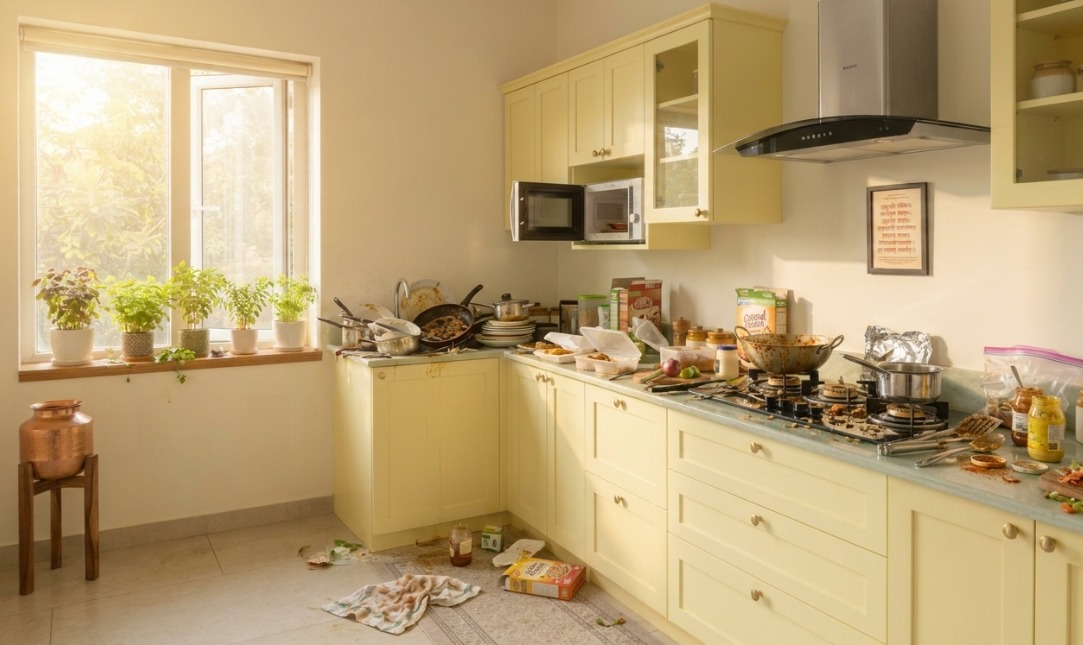
Poor internal arrangement - An inefficient arrangement of the cooking hob, sink, refrigerator and storage can make the kitchen uncomfortable and difficult to use.
This is a practical concern that should be addressed before considering any symbolic remedy.
4) Practical Vastu Remedies for a East Kitchen (Without Demolition)
If the kitchen is already located in the East, relocating it may not be practical. The focus should therefore be on improving its internal arrangement.
A. Reposition the cooking hob
The cooking hob is the most important functional element to examine.
If the layout permits, position the cooking hob towards the South-East portion of the kitchen.
Preferably arrange it so that the person cooking faces East.
Ensure that the hob is positioned safely, with adequate working space and proper ventilation.
The South-East portion within the kitchen is not necessarily the Agneya Kon of the entire house. Moving the hob within the room improves its internal arrangement but does not change the kitchen's overall location.
B. Organize the sink and water facilities
Since East represents Jal + Agni Tattva, water-related facilities should be organized thoughtfully.
If feasible, position the sink towards the North or North-East portion of the kitchen.
Maintain reasonable separation between the sink and cooking hob.
Avoid placing the sink immediately adjacent to the hob.
Ensure that taps and plumbing are in good condition, with no leakage or persistent dampness.
The arrangement should also comply with practical plumbing and hygiene requirements.
C. Maintain Lightness in the East
This is an important non-demolition correction.
Avoid unnecessary heavy storage along the eastern side.
Keep windows and other sources of natural light unobstructed.
Avoid allowing the kitchen to become a dumping or storage area for unused household items.
The objective is to retain as much openness as the available layout permits.
D. Position heavy storage towards South or West
Wherever the kitchen layout allows, heavier storage can be accommodated towards its South or West side.
This may include:
Grain and provision storage.
Large utensils.
Heavy kitchen appliances.
Tall storage cabinets.
However, it should not compromise circulation, accessibility or the structural safety of the cabinets.
E. Improve ventilation and lighting
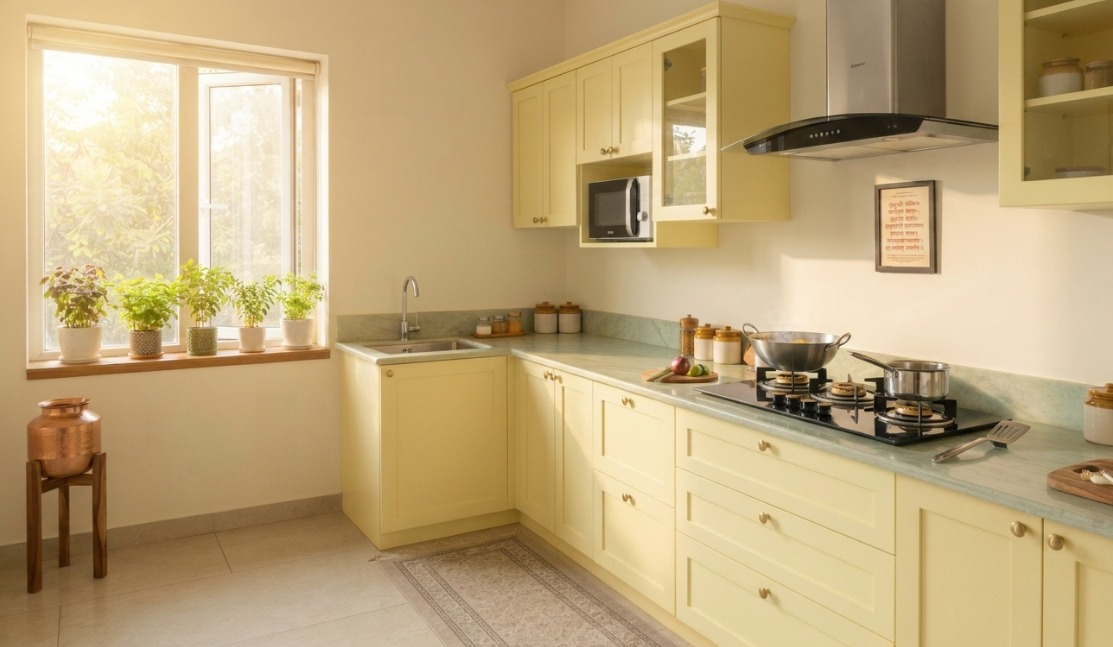
An East kitchen may already receive useful direct morning sunlight, but this depends on its actual surroundings.
Keep windows free from unnecessary obstruction.
Install an effective chimney or exhaust system.
Provide sufficient task lighting over the cooking platform.
Avoid dampness and water accumulation.
F. Use appropriate colours
For an East kitchen, lighter shades can help maintain a bright and open appearance.
Suggested colours include:
Ivory
Cream
Peach
Light green
Light yellow
Avoid excessively dark or visually heavy finishes if the kitchen is small or receives limited daylight.
G. Avoid unnecessary corrective objects
Do not automatically install pyramids, copper strips, yantras or other objects with recommendations from a certified Vastu expert simply because the kitchen is located in the East.
5) What Should You Avoid?
If your kitchen is in the East, keep the following points in mind:
Do not treat the entire East direction as equivalent to the Parjanya pada.
Do not block eastern windows with tall cabinets or unnecessary storage.
Do not place the cooking hob and sink so close that they create practical inconvenience.
Do not undertake demolition merely because the kitchen is not in the South-East.
Do not create excessive clutter and bulky storage in the East.
Do not spend on multiple remedies without first examining the floor plan.
6) When Is a Detailed Vastu Assessment Required?
A general directional assessment may not be sufficient in every case. A detailed assessment becomes important when:
The kitchen occupies more than one pada of the Vastu Purush Mandal.
It extends from East towards North-East or South-East.
The cooking hob, sink and entrance occupy different directional zones.
The kitchen is located close to the Brahmasthan.
There are cuts, extensions or irregularities in the floor plan.
The house has an unusual layout or a combined configuration of multiple flats.
An assessment using the 45-pada Vastu Purush Mandal can help establish the exact Devta padas occupied by the kitchen and distinguish between a kitchen located in Parjanya and one extending into adjoining zones.
Similarly, the position of the cooking hob may influence the internal assessment, even though it does not change the direction occupied by the kitchen itself.
A floor-plan-based assessment is therefore preferable to prescribing the same remedy for every East kitchen.
7) General remedies for East Kitchen
Keep a small glass bowl of unrefined sea salt in the North-East corner of the kitchen to absorb stagnant or conflicting energy, replacing the salt every week.
Hang a copper sun emblem on the East wall of the kitchen to harmonize solar energy without adding physical heat.
Avoid dark red, black, or dark blue on walls and countertops, as these intensify elemental conflicts.
Vastu should guide better planning and harmonious living, not create fear about the homes we already inhabit.