Vastu Purush Mandal - The foundation of Vastu Shastra
From the single-square Sakala Mandala to the 1,024-pada Indrakanta Mandala, the traditional classification demonstrates the use of geometric arrangements for structures of varying nature, scale and complexity. Understanding these Mandalas helps us appreciate how traditional Indian architecture combined geometry, spatial organisation, symbolism and the placement of devtas into a systematic design framework.
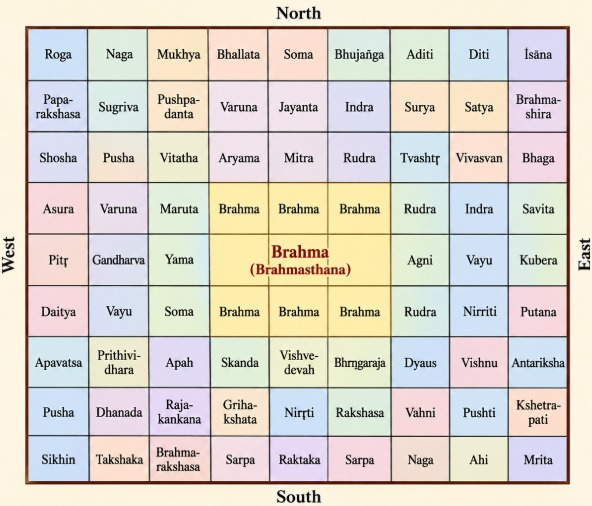
Vastu Purush Mandal is one of the fundamental concepts of traditional Indian architecture. It provides a systematic geometric framework for planning and organising a site and the structures built upon it.
Below are three pillars of Vastu Purush Mandal:
Mandal - an organised arrangement or diagram
Pada - an individual square or division within the mandal.
Pada Vinyas – A method of division where a square is divided into smaller, equal squares to create a grid
Although the 9×9 Vastu Purush Mandal is widely recognised and commonly used in residential Vastu studies, Vastu Shastra describes total 32 Mandals, each having a distinct name, grid configuration and traditional application. Each Mandal is unique to the nature, scale and purpose of structure being planned.
How to calculate the squares in a Mandal
The classification is based on the number of equal divisions made along each side of a square. Dividing the entire structure into a grid of squares, called Pada Vinyas, is the first stage any Vastu Consultant undertakes.
The number of padas is obtained by multiplying the number of divisions on one side by itself.
Thus,
1x1 = 1 pada
2x2 = 4 padas
4×4 = 16 padas
8×8 = 64 padas
9×9 = 81 padas
16×16 = 256 padas
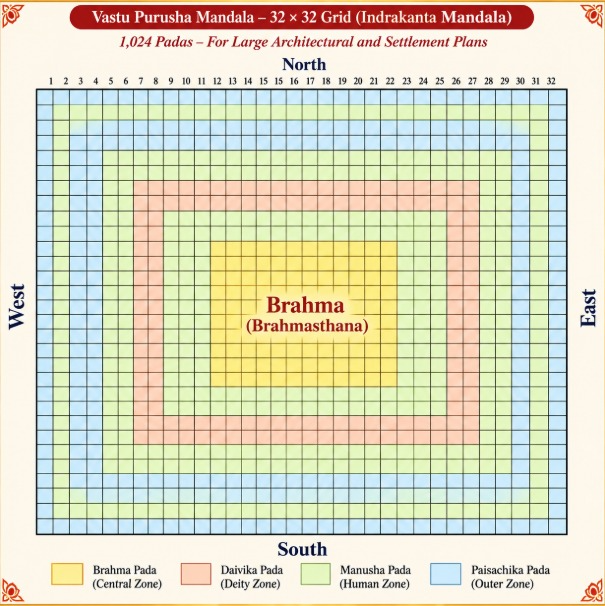
32×32 = 1,024 padas
Different types of Vastu Purush Mandals (Total 32)
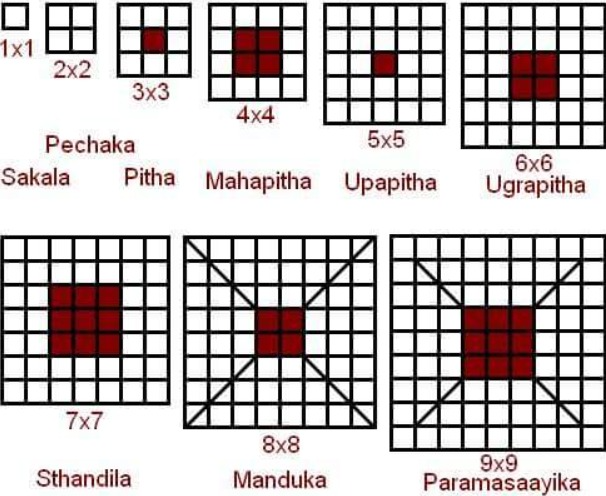
No. | Mandal Name | Grid and Padas | Used for |
1 | Sakala | 1x1 = 1 Pada | Fire altars and ritual arrangements |
2 | Pechaka | 2x2 = 4 Padas | Seats and smaller platforms |
3 | Pitha | 3x3 = 9 Padas | Seats and smaller platforms |
4 | Mahapitha | 4x4 = 16 Padas | Larger seats and elevated platforms |
5 | Upapitha | 5x5 = 25 Padas | Larger seats and elevated platforms |
6 | Ugrapitha | 6x6 = 36 Padas | Larger seats and elevated platforms |
7 | Sthandila | 7x7 = 49 Padas | Mandapas |
8 | Manduka (Chandita) | 8x8 = 64 Padas | Temples and Religious places |
9 | Paramasayika (Ekashiti) | 9x9 = 81 Padas | Residences |
10 | Asana | 10x10 = 100 Padas | Buildings |
11 | Sthaniya | 11x11 = 121 Padas | Buildings |
12 | Desiya | 12x12 = 144 Padas | Larger architectural and settlement layouts |
13 | Ubhayachandita | 13x13 = 169 Padas | Larger architectural and settlement layouts |
14 | Bhadramahasana | 14x14 = 196 Padas | Larger architectural and settlement layouts |
15 | Padmagarbha | 15x15 = 225 Padas | Larger architectural and settlement layouts |
16 | Triyuta | 16x16 = 256 Padas | Larger architectural and settlement layouts |
17 | Vratabhoga | 17x17 = 289 Padas | Larger architectural and settlement layouts |
18 | Karnashtaka | 18x18 = 324 Padas | Larger architectural and settlement layouts |
19 | Ganita | 19x19 = 361 Padas | Larger architectural and settlement layouts |
20 | Suryavishalaka | 20x20 = 400 Padas | Large-scale settlement and urban planning |
21 | Susamhita | 21x21 = 441 Padas | Large-scale settlement and urban planning |
22 | Supratikanta | 22x22 = 484 Padas | Large-scale settlement and urban planning |
23 | Vishala | 23x23 = 529 Padas | Large-scale settlement and urban planning |
24 | Vipragarbha | 24x24 = 576 Padas | Large-scale settlement and urban planning |
25 | Vishvesha | 25x25 = 625 Padas | Large-scale settlement and urban planning |
26 | Vipulabhoga | 26x26 = 676 Padas | Large-scale settlement and urban planning |
27 | Vipratikanta | 27x27 = 729 Padas | Large-scale settlement and urban planning |
28 | Vishalaksha | 28x28 = 784 Padas | Large-scale settlement and urban planning |
29 | Viprabhaktika | 29x29 = 841 Padas | Large-scale settlement and urban planning |
30 | Vishveshasara | 30x30 = 900 Padas | Large-scale settlement and urban planning |
31 | Ishvarakanta | 31x31 = 961 Padas | Large-scale settlement and urban planning |
32 | Indrakanta | 32x32 = 1024 Padas | Large-scale settlement and urban planning |
Why are the 64-pada and 81-pada Mandalas particularly important?
The 64-Pada mandal is specifically used while constructing temples, and the 81-Pada mandal is used for residential houses, commercial shops, offices and factories. Since in current times, these are the most used establishments, their popularity and usage has soared.
However, it should be noted that Vastu Consultants are using the 81-Pada mandal for almost all structures. Correct classification of the structure being constructed, and the mandal required for the same, should be accurately ascertained before any work is undertaken.
An interesting feature is that both Mandala accommodate the traditional arrangement of 45 Devtas, although their individual spatial distribution differs.
In the 9×9 Mandal, Brahma occupies the central nine squares, whereas in the 8×8 Mandala, Brahma occupies four central squares.
This is why understanding the grid is important before studying the individual Devtas.
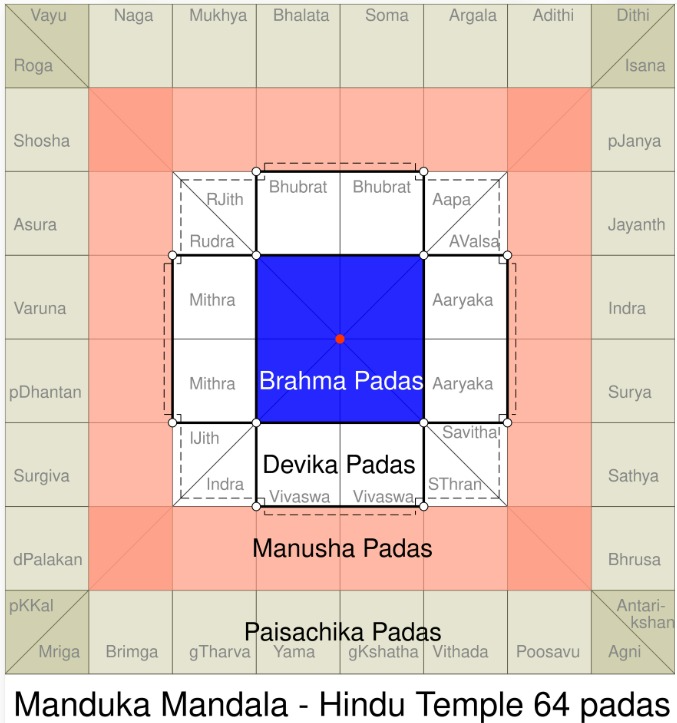
All mandals are not occupied by same devtas though
The arrangement and distribution of devtas depend on the particular Mandal. The 45-Devta arrangement commonly discussed in residential Vastu is not a universal arrangement that can simply be transferred to all 32 grids.
Different configurations, their central areas, peripheral divisions as well as associated devtas are discussed in length in Vastu Shastra literature.
Therefore, the study of each Mandal requires an examination of:
Its overall geometric arrangement.
Its central Brahmasthan.
The number and position of individual padas.
The Devtas occupying the respective padas.
Its architectural application.
This is also the reason why a separate study of each Mandal is necessary rather than treating every grid as a variation of the 9×9 residential plan.
The 9×9 Paramasayika Mandal is particularly relevant to residential Vastu, but it is only one part of this extensive architectural knowledge.