Queen Veeravati Katha: The Traditional Story of Karwa Chauth
The Story of Queen Veeravati is the central legend narrated during the Karwa Chauth fast, highlighting the power of devotion, love, and strict adherence to ritual laws.
Birth of Veeravati
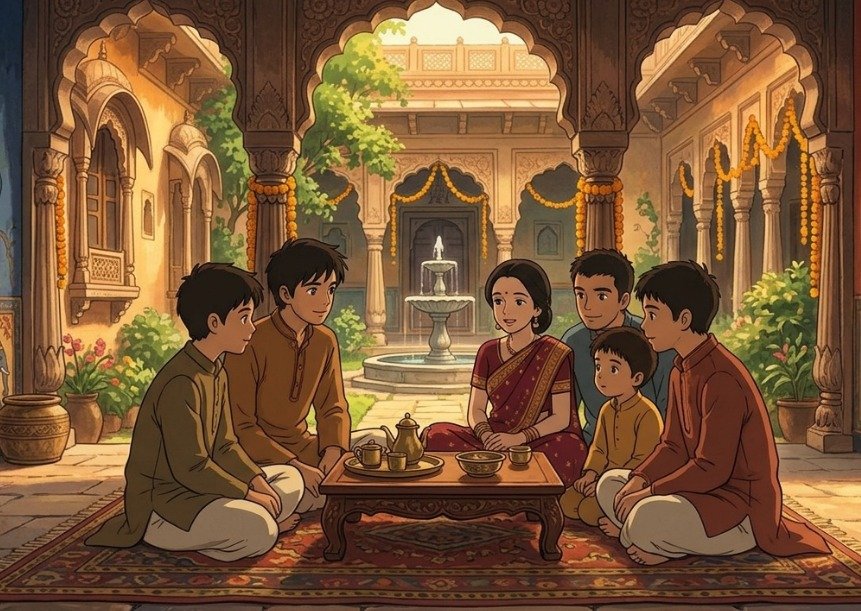
Once upon a time, in the kingdom of Indraprastha, there lived a learned Brahmin named Ved Sharma with his wife, Leelavati. They had seven sons and one daughter named Veeravati.
Veeravati’s seven brothers loved her dearly and always tried to keep her happy.
When Veeravati grew up, she was married to a noble and righteous king.
Veeravati observes her first Karwa Chauth
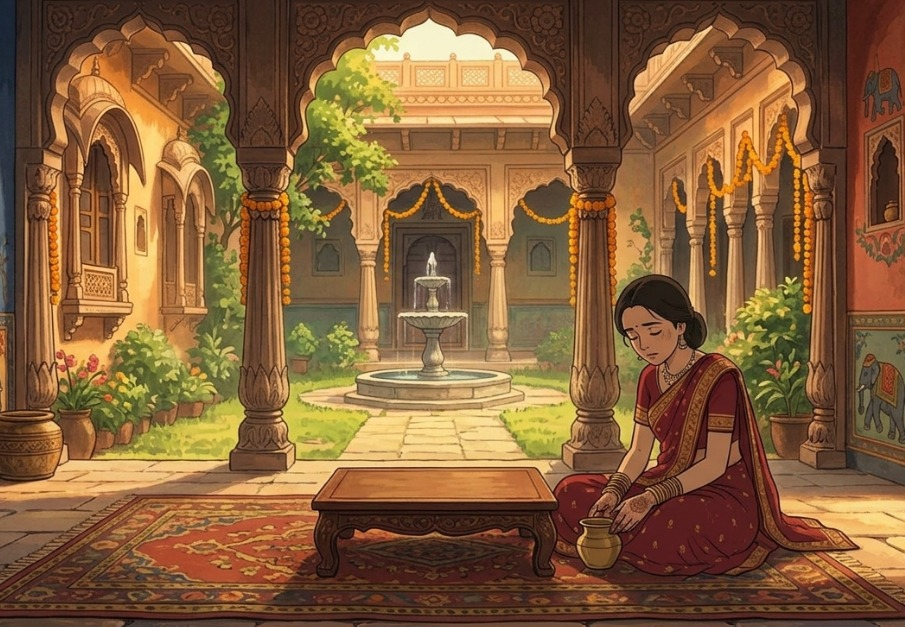
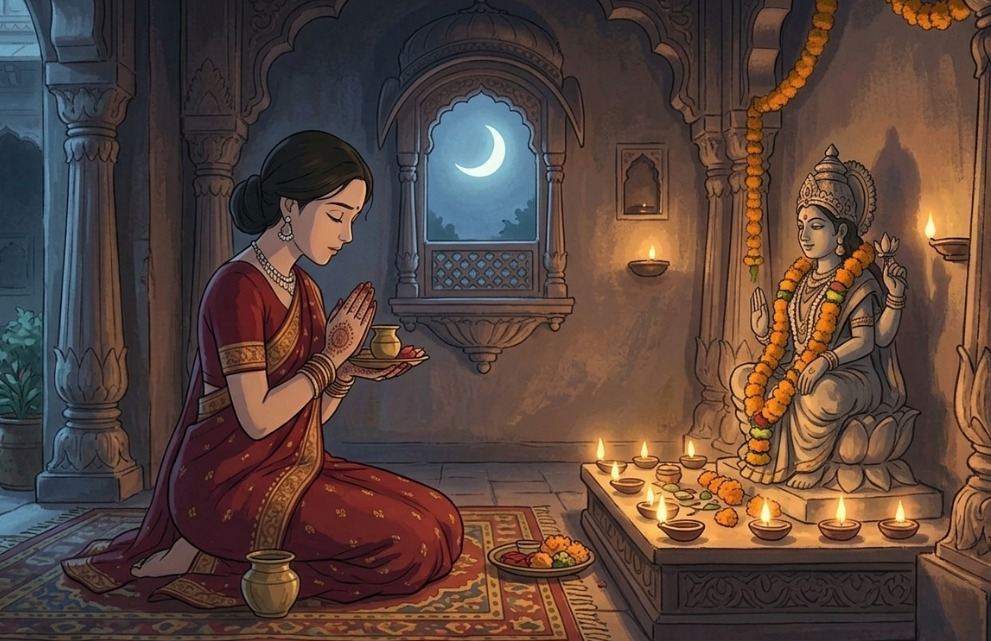
After her marriage, when Veeravati visited her parental home for the first time, she observed Karwa Chauth along with her mother and sisters-in-law. She undertook the fast with great devotion, praying for the long life and well-being of her husband.
She observed the fast without eating or drinking and waited for the Moon to rise so that she could offer arghya and complete her vrat.
As the day passed, however, she became increasingly weak from hunger and thirst. By evening, she was totally exhausted and pale.
Her seven brothers were deeply distressed to see their beloved sister suffering. They knew that she would not eat anything until she saw the Moon, so they decided to find a way to persuade her to break her fast.
Her brothers create a false moon
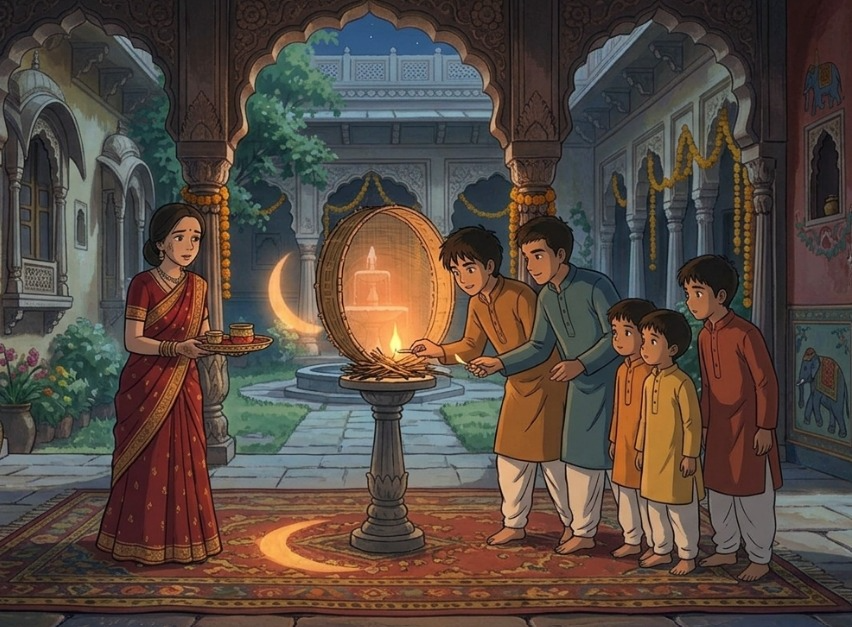
One of the brothers climbed a distant tree and lit a lamp behind a channi (sieve). From a distance, the light resembled the rising Moon.
The other brothers brought Veeravati to a place from where she could see the light. They told her that the Moon had risen and that she could now complete her fast.
However, she asked her brothers, that my sister-in laws moon has not risen, then how my moon has risen. They convinced her that sister-in-laws moon will also rise, but you break your fast.
Veeravati trusted her brothers. Believing the light to be the real Moon, she offered water to it and broke her fast.
She began eating. However, immediately thereafter, she encountered three ill omens: she found a hair in the first mouthful, sneezed after the second, and before she could finish the third, news arrived from her in-laws' home. The King had suddenly fallen into a lifeless stupor, his body mysteriously pierced with hundreds of sharp needles.
The tragic news
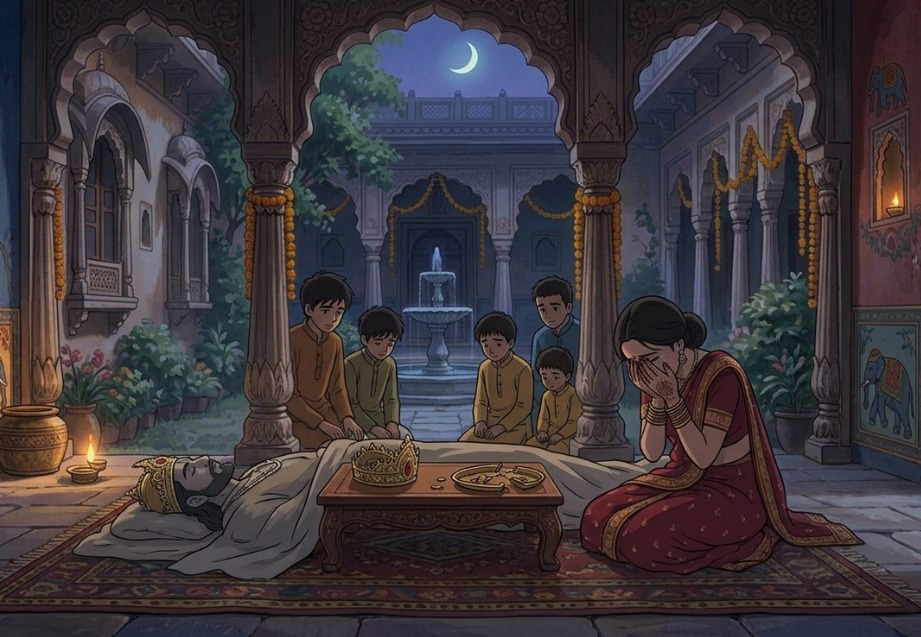
Veeravati was summoned to her husband's home. When she arrived, she discovered that her husband had died.
Overcome with grief, she wept bitterly. She could not understand why such a terrible misfortune had occurred on the very day she had undertaken a vrat for his well-being.
She wondered whether she had made a mistake in observing the fast.
Goddess Parvati guides Veeravati
Hearing Veeravati's cries, Goddess Parvati came to console her.
Veeravati pleaded with the Goddess to help her and restore her husband's life.
The Adi-shakti explained that Veeravati had broken her fast before the actual Moon had risen and had therefore not completed the prescribed observance.
The Goddess instructed Veeravati to serve her unconscious husband with devotion, pull out the needles from his body one by one every day for an entire year, and observe every monthly Chaturthi fast until the next Karwa Chauth arrived.
The Servant Becomes the Queen
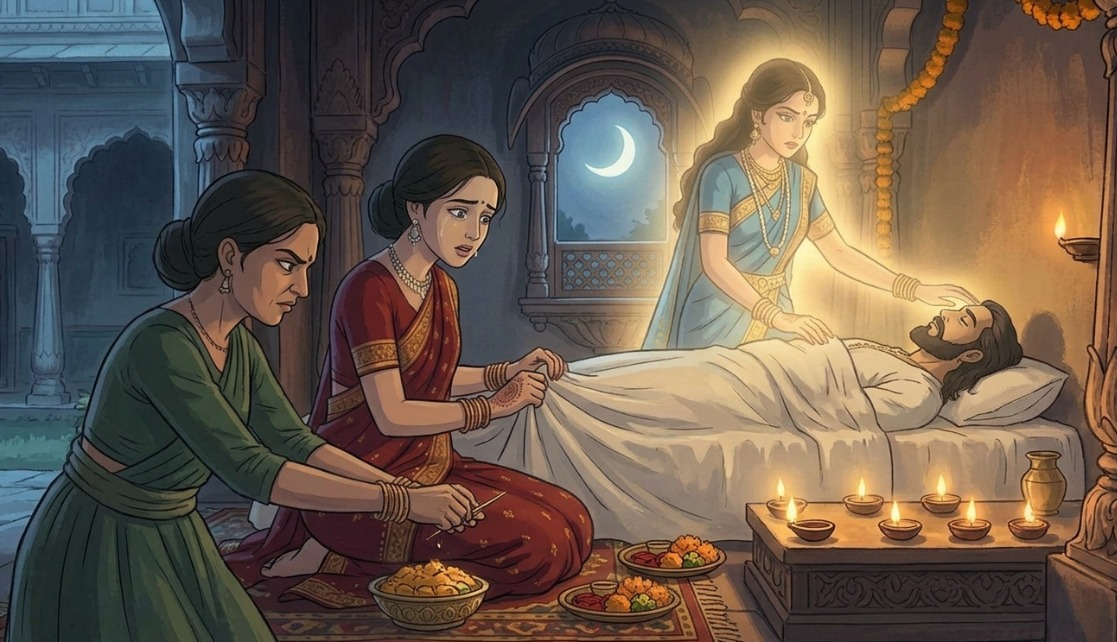
A year passed, and the next Karwa Chauth approached. By then, Veeravati had removed nearly all the needles from her husband’s body. Only one needle remained.
On the day of Karwa Chauth, the Karwa seller was passing buy and Veeravati went to buy karwa for her fast, Meanwhile, she asked her maid to look after the King. The maid removed the final needle from the king’s body.
The king regained consciousness and opened his eyes. However, the maid was the first person he saw and upon maid saying that she is the queen, King believed and accepted her as his wife and gave her the position and honour of the queen.
Veeravati, who had spent an entire year caring for her husband and removing the needles, was left with the status of a servant.
Despite this injustice, Veeravati did not abandon her husband or lose faith. She continued to serve in the palace, waiting patiently for the truth to emerge and remained devoted to her husband. She would often sing a traditional line that expressed the reversal of her fate:
"Rani si oh Goli hoyi, Goli se oh Rani hoyi")
Meaning, the queen had become a servant, and the servant had become the queen.
Veeravati plays with her doll
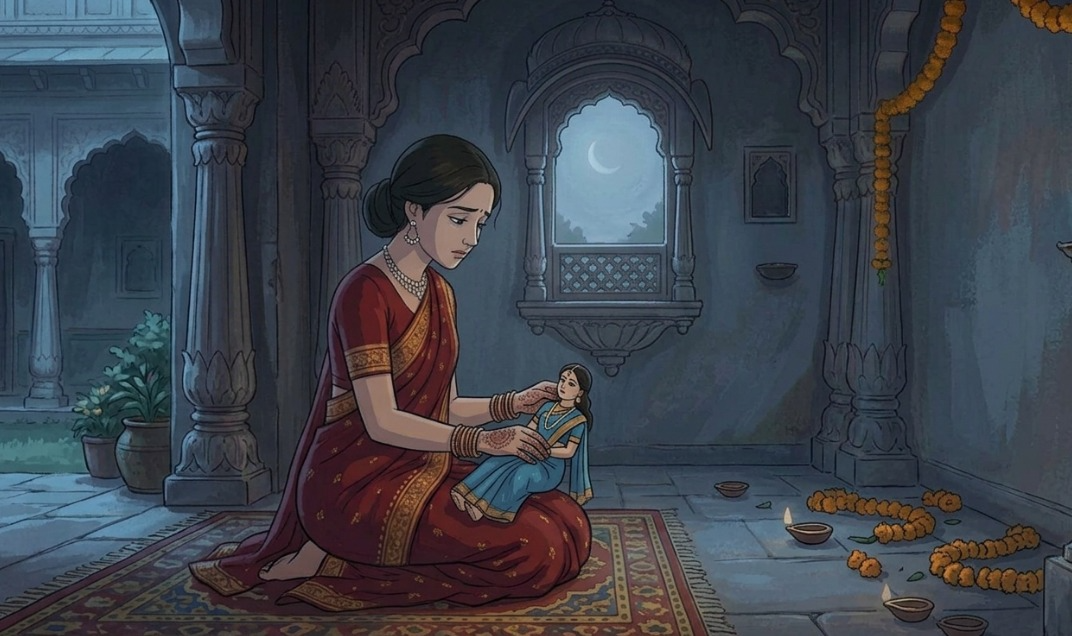
After a few days, the King had to go overseas. He asked his queen (originally maid) what she wanted. She asked for lots of jewellery. The King also asked Veeravati what she wanted. Veeravati only asked for a doll to play with.
After completing his work, the King came back. He gave the doll to Veeravati. Veeravati started playing with her doll and repeating,” Rani si oh Goli hoyi, Goli se oh Rani hoyi”.
How the truth was revealed
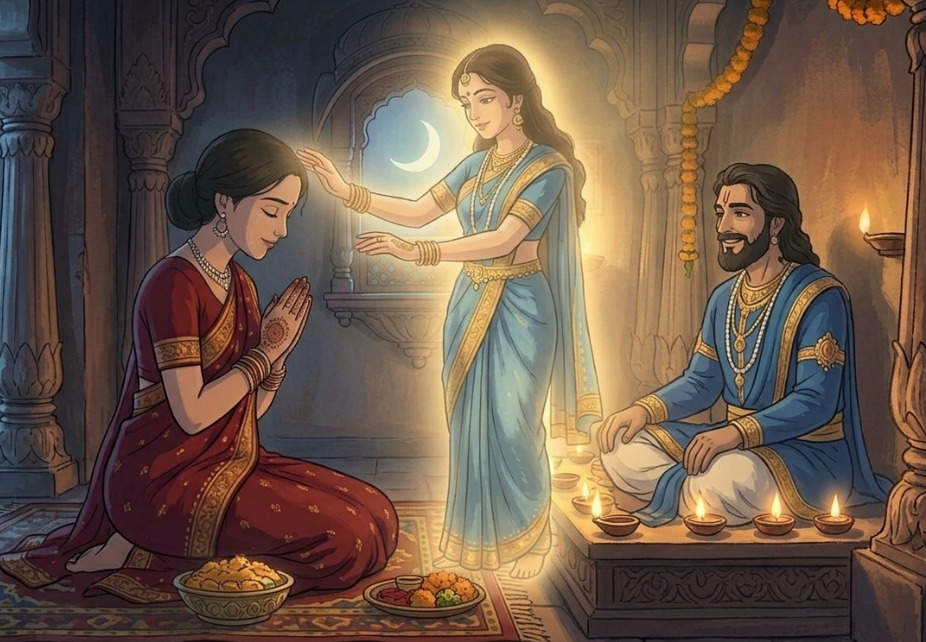
One day, the king heard Veeravati singing these words. Curious about their meaning, he asked her why she repeated them. Veeravati then revealed the truth about the past year—how she had cared for him, how she had removed the needles from his body one by one, and how the maid had removed the final needle and been mistaken for the queen.
On hearing her account, the king was confused as to the actual happenings. He decided to test the situation. The King had a white sheet spread in his court and ordered the maid (actually Veeravati) to walk on it. The white sheet remained white with not a single speck of dust on it. Then he asked the queen (actually the maid) to walk on it. As soon as she walked, the white sheet turned soiled.
The King understood that the woman he had been treating as a servant was his true wife, Veeravati, who had remained beside him through his suffering.
The truth was revealed, Veeravati’s rightful place was restored, and the maid’s deception came to light. The king and queen were reunited, and Veeravati’s patience and devotion were finally acknowledged.
Veeravati and her husband were reunited and lived happily.
According to the katha, the merit of her devotion and observances brought her husband back to life as well as back in her life.