Shatabhisha Nakshatra
शतभिषा नक्षत्र
Shatabhisha is the twenty-fourth Nakshatra in Vedic astrology, symbolized by an empty circle and ruled by Rahu and Lord Varuna. Discover its core astrological features, symbol, four padas, and practical suitability for healing spaces, perimeter security, water Vastu, and Panchak precautions.
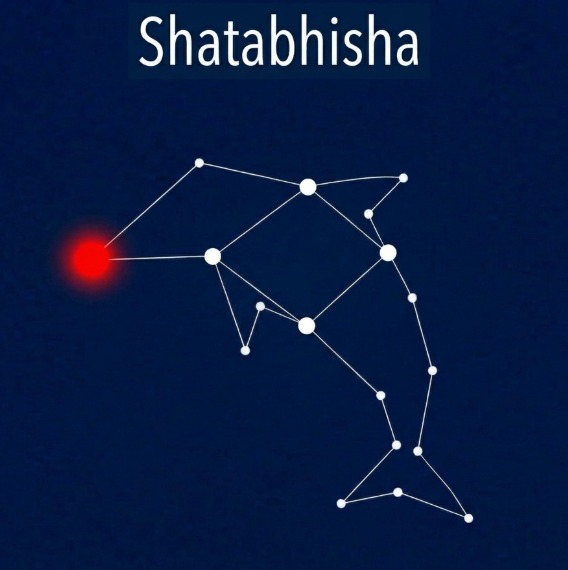
Shatabhisha derives its name from Shata (hundred) and Bhishaj (healer or physician), meaning "a hundred healers" or "requiring a hundred remedies." It is the twenty-fourth Nakshatra in the 27-Nakshatra sequence and lies entirely within the airy, visionary sign of Aquarius, embodying cosmic healing, protective boundaries, technological innovation, and deep mysticism.
The empty circle or hundred stars symbolises containment, sacred enclosure, secrecy, cyclical renewal, and protective shielding. Consequently, Shatabhisha is traditionally associated with enclosed compounds, holistic healing spaces, water purification, and boundary protection.
Nakshatra | |
Nakshatra (Constellation) | Shatabhisha |
Nakshatra Grah (Planet) | Rahu |
Symbol | Empty Circle / Hundred Stars / Veil |
Yes (All 4 Padas) | |
No | |
Nadi | Aadya |
Yoni | Ashwa (Horse) |
Gana | Rakshasa |
Aaradhya-Vriksh | Kadamba (Neolamarckia cadamba) |
Daan | Sharkara |
Devta | Varun Devta (God of Cosmic Waters, Oceans & Universal Law) |
Urdhwamukh (Upward-facing) | |
Manda Lochan (Dim-Eyed Nakshatra) | |
Akasha (Ether / Space) | |
Chara / Chala (Movable & Dynamic) | |
Core traits | Independent, analytical, secretive, humanitarian, innovative, perceptive, and focused on healing, boundaries, and deeper truths |
Nakshatra Rashi | |
Rashi | Aquarius |
Degree | 06°40′ – 20°00′ in Aquarius |
Rashi Grah (Planet) | Shani (Saturn) |
Rashi Varna | Shudra |
Rashi Vashya | Dwipad / Manav (Human) |
Rashi Tatva | Vayu (Air) |
Nakshatra Padas | ||||
Details | First Pada | Second Pada | Third Pada | Fourth Pada |
Pada Rashi | Dhanu (Sagittarius) | Makar (Capricorn) | Kumbh (Aquarius) | Meen (Pisces) |
Degrees | 06°40′ – 10°00′ | 10°00′ – 13°20′ | 13°20′ – 16°40′ | 16°40′ – 20°00′ |
Pada Planet | Guru (Jupiter) | Shani (Saturn) | Shani (Saturn) | Guru (Jupiter) |
Letter (English) | Go | Sa / Saa | Si / See | Su / Soo |
Letter (Hindi) | गो | सा | सी | सू |
Traits | Philosophical, idealistic, truth-seeking, and expansive | Disciplined, practical, structured, and privacy-loving | Innovative, unconventional, research-driven, and independent | Empathetic, mystical, compassionate, and healing-oriented |
Property and Vastu Suitability under Shatabhisha Nakshatra
Hospitals, Clinics & Healing Centers (Highly Favorable): Known as the star of "a hundred healers," Shatabhisha is uniquely auspicious in Vastu for setting up clinics, Ayurvedic centers, wellness retreats, pharmacies, and rehabilitation spaces.
Boundary Walls, Fencing & Privacy Enclosures (Highly Favorable): Symbolized by an empty circle (protective containment), it is ideal for constructing compound walls, perimeter fencing, and securing private estates.
Water Bodies, Rainwater Harvesting & Filtration (Favorable): Governed directly by Varun (Lord of Cosmic Waters), it supports installing water purification systems, rainwater harvesting tanks, and coastal or waterfront infrastructure.
Research Labs, Tech Hubs & Smart Home Systems (Favorable): Ruled by Rahu in Aquarius, it aligns well with setting up data centers, laboratories, solar grids, and modern home automation.
The Panchak Precaution & Residential Griha Pravesh (Avoid): Because Shatabhisha falls entirely within Panchak and carries Rakshasa Gana, traditional Vastu Muhurta strictly avoids it for casting roofs (Chhat), collecting timber, buying a family home, or performing residential Griha Pravesh to prevent isolation or hidden structural defects.
Shatabhisha Nakshatra is best harnessed in Vastu for establishing healing spaces, fortifying protective boundaries, and managing water systems rather than initiating domestic Griha Pravesh or roof construction during Panchak.