Purva Ashadha Nakshatra
पूर्वाषाढ़ा नक्षत्र
Purva Ashadha is the twentieth Nakshatra in Vedic astrology, symbolized by a hand fan and ruled by Venus and Apas (the water deity). Discover its core astrological features, symbol, four padas, and practical suitability for borewells, water features, excavation, and Vastu cleansing.
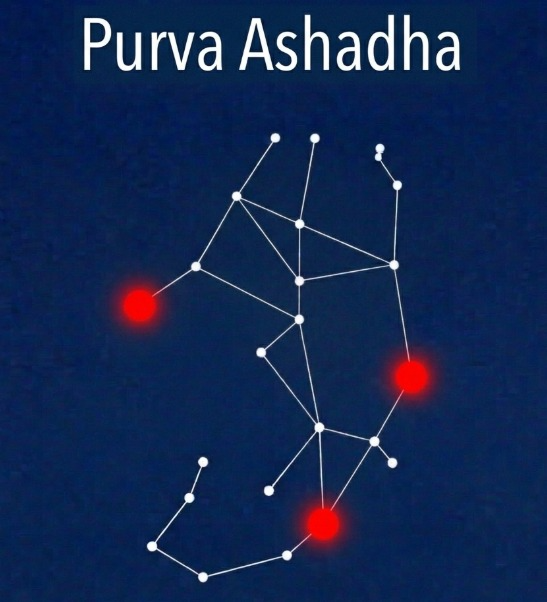
Purva Ashadha derives its name from Purva (former) and Ashadha (invincible or unconquered), meaning "the former invincible one" or "early victory." It is the twentieth Nakshatra in the 27-Nakshatra sequence and lies entirely within the fiery, expansive sign of Sagittarius, embodying purification, enthusiasm, creative flow, and unstoppable momentum.
The hand fan or winnowing basket symbolises separating the essential from the chaff, refreshing stagnant air, fanning inner vitality, and invigorating spaces. Consequently, Purva Ashadha is traditionally associated with water abundance, purification, artistic inspiration, and energetic revitalization.
Nakshatra | |
Nakshatra (Constellation) | Purva Ashadha |
Nakshatra Grah (Planet) | Shukra (Venus) |
Symbol | Hand Fan / Winnowing Basket / Elephant Tusk |
No | |
No | |
Nadi | Madhya |
Yoni | Vanara (Monkey) |
Gana | Manushya |
Aaradhya-Vriksh | Jalavetasa / Ashoka (Water Willow / Salix tetrasperma) |
Daan | Clothes / Kambal |
Devta | Apas (Cosmic Waters & Goddess of Purification) |
Adhomukha Nakshatra (Downward-Facing) | |
Andha Lochan (Blind-Eyed Nakshatra) | |
Vayu (Air) | |
Ugra / Krura (Fierce & Aggressive) | |
Core traits | Enthusiastic, persuasive, creative, independent, courageous, rejuvenating, and driven by conviction and renewal |
Nakshatra Rashi | |
Rashi | Sagittarius |
Degree | 13°20′ – 26°40′ in Sagittarius |
Rashi Grah (Planet) | Guru (Jupiter) |
Rashi Varna | Kshatriya |
Rashi Vashya | Chatushpad (Four-legged) |
Rashi Tatva | Agni (Fire) |
Nakshatra Padas | ||||
Details | First Pada | Second Pada | Third Pada | Fourth Pada |
Pada Rashi | Simha (Leo) | Kanya (Virgo) | Tula (Libra) | Vrishchik (Scorpio) |
Degrees | 13°20′ – 16°40′ | 16°40′ – 20°00′ | 20°00′ – 23°20′ | 23°20′ – 26°40′ |
Pada Planet | Surya (Sun) | Budh (Mercury) | Shukra (Venus) | Mangal (Mars) |
Letter (English) | Bhu (Bu) | Dha | Pha / Fa | Dha / Dhha / Dha |
Letter (Hindi) | भू | धा | फा | ढा |
Traits | Proud, visionary, charismatic, and leadership-oriented | Practical, discerning, organized, and detail-focused | Artistic, harmonious, refined, and socially graceful | Intense, deeply intuitive, transformative, and resilient |
Property and Vastu Suitability under Purva Ashadha Nakshatra
Wells, Borewells & Underground Water Reservoirs (Highly Favorable): Governed directly by Apas (the deity of cosmic waters) with an Adhomukh (downward-facing) orientation, Purva Ashadha is one of the finest stars in Vastu for digging wells, borewells, underground water tanks, and swimming pools.
North-East (Ishan) Water Elements & Cleansing Rituals (Highly Favorable): Aligning with Apas's purifying water energy, it is ideal for installing fountains, water bodies, and performing Jalabhishek or space purification rituals.
Ventilation, Cooling Systems & Decluttering (Favorable): Symbolized by the hand fan and winnowing basket, it supports installing air-conditioning, ventilation fans, and clearing clutter to separate useful essentials from stagnant waste.
Demolition & Deep Excavation (Favorable): Because Purva Ashadha falls under the Ugra (fierce) category and faces downward, it works well for digging foundations and tearing down old structures before rebuilding.
Routine Residential Purchase & Griha Pravesh (Generally Avoided): Due to its Ugra (intense) classification, traditional Vastu Muhurta generally avoids Purva Ashadha for purchasing a permanent home or performing Griha Pravesh, favoring its successor Uttara Ashadha (Dhruva/fixed) for lasting residential stability.
Purva Ashadha Nakshatra is best harnessed in Vastu for tapping underground water sources, purifying stagnant environments, and refreshing airflow rather than anchoring calm, permanent domestic occupancy.