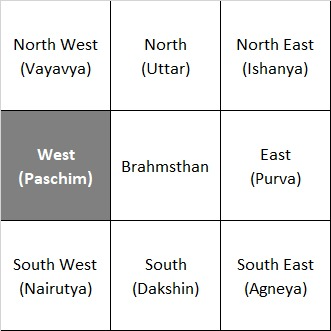
Pashchim Disha (West)
पश्चिम दिशा
Pashchim Disha, or the West direction, is associated with Varuna Dev and the qualities of discipline, depth and fulfilment. It represents perseverance, introspection and the rewards of sustained effort, making it a suitable zone for dining spaces, children's bedrooms, study areas and heavier furniture.

The word "Pashchim" (पश्चिम) in Sanskrit means West, the direction in which the Sun sets. In Vedic tradition, the West is governed by Varuna, the deity associated with water, cosmic order, moral law and the celestial waters. Varuna is regarded as the guardian deity (Dikpala) of this direction. He represents discipline, justice, truth, depth and the regulation of natural forces. Therefore, Pashchim Disha is associated with fulfilment, introspection, discipline, prosperity and the completion of activities.
Planet
West is commonly associated with the planet Saturn (Shani). Saturn represents discipline, patience, hard work, responsibility and perseverance. Its association with the West highlights the importance of commitment, consistency and the rewards that come through sustained effort.
Element
Water element (Jal Tattva) is associated with Varuna, the presiding deity of the West. Water symbolises depth, continuity, nourishment and the ability to sustain life. In Vastu practice, however, West is an amalgamation of Earth and Air energies. Its connection with Varuna provides an important traditional association with water. Thus this direction is directly affected by three elements.
Best: What Should Be Placed Here
Dining Room: The West can be considered for a dining room or family gathering space. It provides an opportunity to create a comfortable area for shared meals and interaction.
Children's Bedroom: The West is traditionally considered suitable for children's bedrooms, particularly for older children. The exact suitability should be assessed in relation to the complete floor plan and the occupants' requirements.
Study and Learning Spaces: A study room or learning area can be considered in this direction. It can provide a quiet and focused environment for reading, studying and intellectual activities.
Storage and Heavy Furniture: Cupboards, wardrobes and other substantial furniture can be placed along the western side. The West is traditionally considered suitable for relatively heavier structures compared with the North and East.
Windows and Openings: Windows can be provided to facilitate natural ventilation and daylight. Since the western Sun can bring considerable afternoon heat, appropriate shading and sun-control measures should be incorporated.
Avoid: What Not to Do Here
Underground Water Bodies: Large underground water tanks and borewells are generally not the first preference for this direction in commonly followed Vastu practice. Their suitability should be considered in relation to the complete layout.
Excessive Open Spaces: Avoid keeping the western side excessively open or significantly lower than the East. Traditionally, the West is preferred to be relatively heavier and more enclosed.
Unprotected Large Openings: Avoid excessively large west-facing windows without suitable shading, as they can allow significant afternoon heat into the building. This is also an important consideration from an architectural and energy-efficiency perspective.
Excessive Clutter: Avoid accumulating broken furniture, unused articles and waste materials. Keeping the western zone organised helps maintain a functional and balanced environment.
Poorly Planned Water Installations: Although Varuna is associated with water, this does not mean that every water-related installation is automatically suitable in the West. Water bodies and tanks should be positioned according to the specific Vastu framework and practical requirements.