Nakshatra Drishti
नक्षत्र दृष्टि
Nakshatra Drishti (Lochan) classifies the lunar constellations into four sight-based categories in Vedic astrology. Astrologers use this system to track lost property or documents and to pick clear-eyed days for inspecting real estate and verifying legal titles.
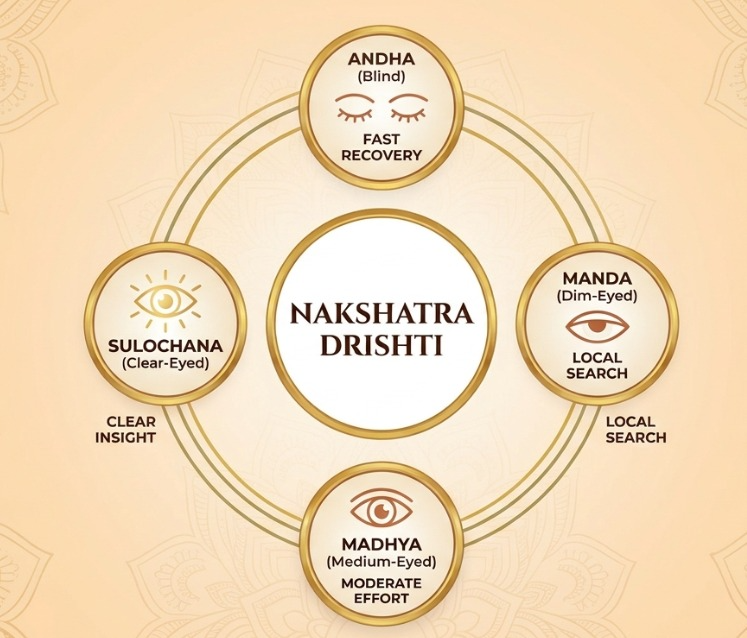
In classical Vedic astrology (Muhurat Shastra), Nakshatra Drishti—also known as Nakshatra Lochan (gaze or sight)—classifies the nakshatra into four categories based on how they "see" or reveal things. Astrologers and Vastu experts use this system to predict whether lost property, missing documents, or stolen valuables will be recovered, as well as to pick sharp, clear-eyed days for inspecting land and verifying legal deeds.
The 4 Types of Nakshatra Drishti
1) Andha Lochan (Blind-Eyed Nakshatras)
Nakshatras in this group: Rohini, Pushya, Uttara Phalguni, Vishakha, Purva Ashadha, Dhanishta, and Revati.
Core Energy: Because these stars are symbolically "blind" to hiding places, anything misplaced during them cannot stay hidden for long.
Property & Recovery Rules: If keys, cash, or property papers go missing under an Andha Lochan star, they are usually found quickly and close to home (traditionally toward the East).
2) Manda Lochan (Dim-Eyed Nakshatras)
Nakshatras in this group: Ashwini, Mrigashira, Ashlesha, Hasta, Anuradha, Uttara Ashadha, and Shatabhisha.
Core Energy: Sight is partial or hazy, requiring active searching and persistence.
Property & Recovery Rules: Lost items or misplaced documents during these stars are recoverable, but only after deliberate effort and asking around.
3) Madhya / Kana Lochan (Medium / One-Eyed Nakshatras)
Nakshatras in this group: Bharani, Ardra, Magha, Chitra, Jyeshtha, Purva Bhadrapada, and Abhijit.
Core Energy: You gain awareness of what happened, though physical retrieval becomes difficult.
Property & Recovery Rules: If an item or boundary dispute arises here, you will likely learn who took it or where the issue lies, though recovering the physical asset requires strong intervention.
4) Sulochana (Clear-Eyed Nakshatras)
Nakshatras in this group: Krittika, Punarvasu, Purva Phalguni, Swati, Moola, Shravana, and Uttara Bhadrapada.
Core Energy: Sharp vision, transparency, and far-reaching sight.
Property & Recovery Rules: While items lost under Sulochana travel far away and are hard to retrieve, these are the best stars for property inspection, title verification, and land measurement, as no hidden structural or legal flaw escapes notice.