Magha Nakshatra
मघा नक्षत्र
Magha is the tenth Nakshatra in Vedic astrology, symbolized by the royal throne and ruled by Ketu and the Pitris. Discover its core astrological features, symbol, four padas, and practical suitability for ancestral homes, administrative spaces, excavation, and Vastu remedies.
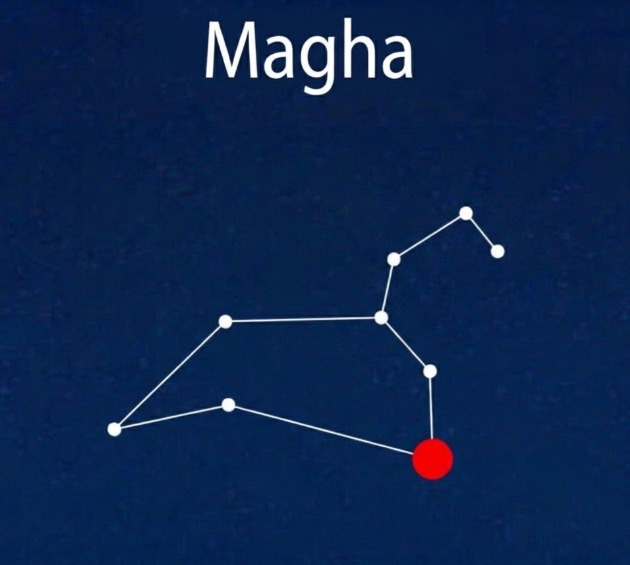
Magha derives its name from Magh, meaning "mighty," "generous," or "bountiful." It is the tenth Nakshatra in the 27-Nakshatra sequence and marks the beginning of the fiery, royal sign of Leo, embodying authority, ancestral lineage, dignity, and sovereign leadership.
The royal throne symbolises power, legacy, honor, and established governance. Consequently, Magha is traditionally associated with ancestral blessings, structural grandeur, authority, and preserving family heritage.
Nakshatra | |
Nakshatra (Constellation) | Magha |
Nakshatra Grah (Planet) | Ketu |
Symbol | Royal Throne / Palanquin |
No | |
Yes | |
Nadi | Antya |
Yoni | Mushak (Rat/Mouse) |
Gana | Rakshasa |
Aaradhya-Vriksh | Bargad (Banyan Tree / Ficus benghalensis) |
Daan | Gud / Namak |
Devta | Pitra (The Ancestral Fathers) |
Adhomukha Nakshatra (Downward-Facing) | |
Madhya / Kana Lochan (Medium / One-Eyed Nakshatra) | |
Jala (Water) | |
Ugra / Krura (Fierce & Aggressive) | |
Core traits | Dignified, authoritative, traditional, proud, generous, principled, and deeply connected to heritage and status |
Nakshatra Rashi | |
Rashi | Leo |
Degree | 00°00′ – 13°20′ in Leo |
Rashi Grah (Planet) | Surya (Sun) |
Rashi Varna | Kshatriya |
Rashi Vashya | Vanchar (Forest-dwelling / Wild) |
Rashi Tatva | Agni (Fire) |
Nakshatra Padas | ||||
Details | First Pada | Second Pada | Third Pada | Fourth Pada |
Pada Rashi | Mesh (Aries) | Vrishab (Taurus) | Mithun (Gemini) | Kark (Cancer) |
Degrees | 00°00′ – 03°20′ | 03°20′ – 06°40′ | 06°40′ – 10°00′ | 10°00′ – 13°20′ |
Pada Planet | Mangal (Mars) | Shukra (Venus) | Budh (Mercury) | Chandra (Moon) |
Letter (English) | Ma | Mi | Mu | Me |
Letter (Hindi) | मा | मी | मू | मे |
Traits | Bold, pioneering, commanding, and ambitious | Luxurious, grounded, artistic, and wealth-preserving | Strategic, eloquent, analytical, and socially influential | Nurturing, protective, deeply devoted to family and lineage |
Property and Vastu Suitability under Magha Nakshatra
Ancestral Property & Heritage Restoration (Highly Favorable): Governed by the Pitra (ancestors) and symbolized by the royal throne, Magha is deeply aligned with inheriting, preserving, or restoring ancestral homes and heritage properties.
Government, Administrative & Grand Spaces (Favorable): Its sovereign Leo energy supports setting up administrative offices, courtrooms, executive boardrooms, and prestigious public institutions.
Underground Excavation & Foundations (Favorable): Supported by Adhomukh (downward-facing) orientation and Jala (Water) Tatva, it is suitable for deep excavation, wells, and structural foundation work—provided the sensitive 1st Pada (Gand Mool junction at 00°00′–03°20′ Leo) is avoided.
Pitru Shanti & Ancestral Vastu Rituals (Highly Favorable): Ideal for performing Pitru Tarpan, Shradh, or Vastu remedies aimed at resolving ancestral (Pitru Dosha) blocks linked to a property.
Routine Residential Purchase & Griha Pravesh (Generally Avoided): Because Magha is classified as an Ugra (fierce) and Gand Mool nakshatra, traditional Vastu Muhurta avoids it for standard residential purchases or Griha Pravesh to prevent ego clashes or heavy burdens in daily domestic life.
Magha Nakshatra should be utilised in Vastu for honoring ancestral lineage, restoring heritage properties, and establishing authoritative spaces rather than initiating routine, everyday domestic beginnings.