Jyeshtha Nakshatra
ज्येष्ठा नक्षत्र
Jyeshtha is the eighteenth Nakshatra in Vedic astrology, symbolized by a protective amulet and ruled by Mercury and Lord Indra. Discover its core astrological features, symbol, four padas, and practical suitability for security setups, boundary fortification, demolition, and residential Vastu.
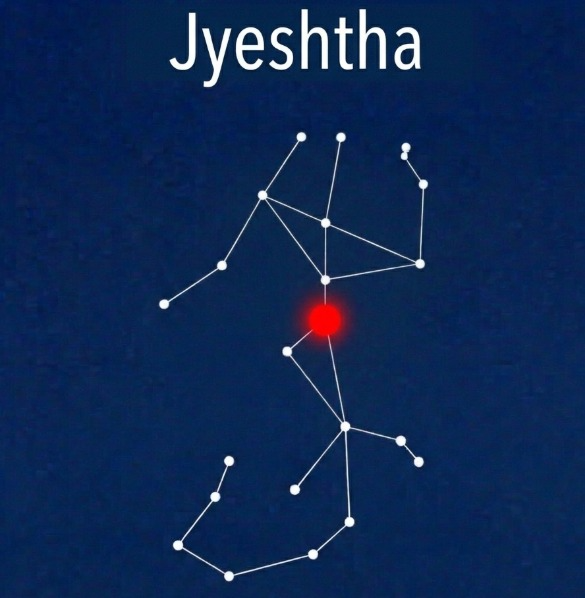
Jyeshtha derives its name from Jyeshtha, meaning "the eldest," "most senior," or "chief." It is the eighteenth Nakshatra in the 27-Nakshatra sequence and occupies the final degrees of the watery, intense sign of Scorpio, embodying seniority, protective authority, strategic wisdom, and mastery over challenges.
The circular amulet, talisman, or earring (Kundala) symbolises spiritual protection, sovereign status, hidden strength, and guarding against unseen harm. Consequently, Jyeshtha is traditionally associated with leadership, defensive fortification, maturity, and decisive control.
Nakshatra | |
Nakshatra (Constellation) | Jyeshtha |
Nakshatra Grah (Planet) | Budh (Mercury) |
Symbol | Circular Amulet / Talisman / Earring (Kundala) |
No | |
Yes | |
Nadi | Aadya |
Yoni | Mriga (Deer) |
Gana | Rakshasa |
Aaradhya-Vriksh | Cheer / Sarala (Chir Pine / Pinus roxburghii) |
Daan | Yams (root vegetables), leafy greens, umbrella |
Devta | Indra (King of the Gods & Protector of Order) |
Tiryakmukha Nakshatra (Horizontal / Forward-Facing) | |
Madhya / Kana Lochan (Medium / One-Eyed Nakshatra) | |
Vayu (Air) | |
Tikshna / Daruna (Sharp & Dreadful) | |
Core traits | Protective, authoritative, strategic, independent, perceptive, courageous, and focused on security, seniority, and control |
Nakshatra Rashi | |
Rashi | Scorpio |
Degree | 16°40′ – 30°00′ in Scorpio |
Rashi Grah (Planet) | Mangal (Mars) |
Rashi Varna | Brahmin |
Rashi Vashya | Keeta (Insect/Reptile) |
Rashi Tatva | Jala (Water) |
Nakshatra Padas | ||||
Details | First Pada | Second Pada | Third Pada | Fourth Pada |
Pada Rashi | Dhanu (Sagittarius) | Makar (Capricorn) | Kumbh (Aquarius) | Meen (Pisces) |
Degrees | 16°40′ – 20°00′ | 20°00′ – 23°20′ | 23°20′ – 26°40′ | 26°40′ – 30°00′ |
Pada Planet | Guru (Jupiter) | Shani (Saturn) | Shani (Saturn) | Guru (Jupiter) |
Letter (English) | No | Ya | Yi | Yu |
Letter (Hindi) | नो | या | यी | यू |
Traits | Principled, commanding, ambitious, and protective | Disciplined, strategic, pragmatic, and authority-driven | Innovative, independent, analytical, and farsighted | Empathetic, intuitive, wise, and spiritually reflective |
Property and Vastu Suitability under Jyeshtha Nakshatra
Security Systems, Vaults & Boundary Fortification (Highly Favorable): Symbolized by a protective talisman and ruled by Indra, Jyeshtha is ideal for installing safes, security cameras, compound walls, heavy gates, and protective Vastu Yantras.
Demolition & Clearing Encroachments (Favorable): Classified as a Teekshna (sharp/intense) nakshatra, it supports tearing down old structures, clearing disputed boundaries, and removing obstacles.
Vastu Raksha & Energetic Protection Rituals (Favorable): Well-suited for performing Vastu Raksha homams, Indra worship, or installing protective thresholds to shield a premises from negative influences.
Executive Offices & Command Centers (Moderately Favorable): Aligns with seniority and leadership, making it workable for setting up head offices or security hubs (provided the sensitive 4th Pada at the Scorpio–Sagittarius Gand Mool junction is avoided).
Residential Purchase, Bhoomi Pujan & Griha Pravesh (Avoid): Because Jyeshtha is both a Teekshna (sharp) and Gand Mool nakshatra, traditional Vastu Muhurta strictly avoids it for buying family homes, laying foundations, or entering a new residence to prevent authority clashes or domestic stress.
Jyeshtha Nakshatra is best harnessed in Vastu for fortifying security, installing protective remedies, and clearing away old obstacles rather than initiating peaceful domestic beginnings.