Ashlesha Nakshatra
आश्लेषा नक्षत्र
Ashlesha is the ninth Nakshatra in Vedic astrology, symbolized by the coiled serpent and ruled by Mercury and the Naga deities. Discover its core astrological features, symbol, four padas, and practical suitability for property security, excavation, demolition, and residential Vastu.
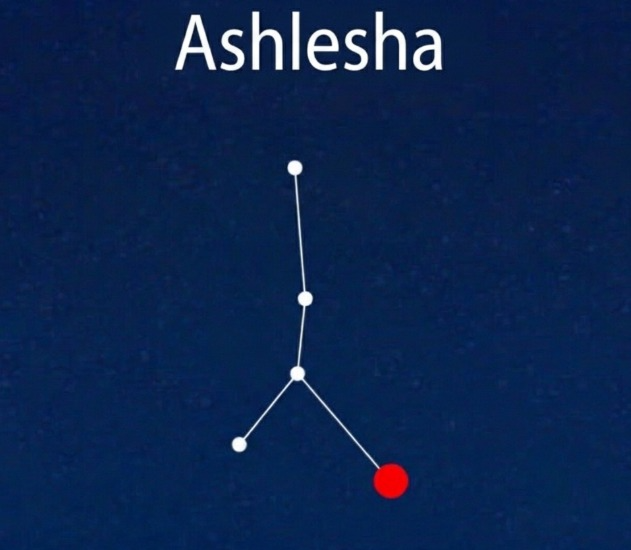
Ashlesha derives its name from Ashlesh, meaning "the entwiner," "clinging," or "intimate embrace." It is the ninth Nakshatra in the 27-Nakshatra sequence and occupies the final degrees of the watery sign of Cancer, embodying deep intuition, mystical wisdom, coiled kundalini energy, and strategic focus.
The coiled serpent symbolises sharp perception, hypnotic influence, Kundalini power, and the ability to bind or protect closely held territory. Consequently, Ashlesha is traditionally associated with psychological depth, occult knowledge, defensive strength, and sharp discernment.
Nakshatra | |
Nakshatra (Constellation) | Ashlesha |
Nakshatra Grah (Planet) | Budh (Mercury) |
Symbol | Coiled Serpent |
No | |
Yes | |
Nadi | Antya |
Yoni | Marjara (Cat) |
Gana | Rakshasa |
Aaradhya-Vriksh | Nagkesar (Cobra's Saffron / Mesua ferrea) |
Daan | Black Sesame / Oil |
Devta | Sarpa / Naga (The Serpent Deities) |
Adhomukha Nakshatra (Downward-Facing) | |
Manda Lochan (Dim-Eyed Nakshatra) | |
Jala (Water) | |
Tikshna / Daruna (Sharp & Dreadful) | |
Core traits | Perceptive, strategic, intuitive, protective, resourceful, secretive, and deeply focused on security and transformation |
Nakshatra Rashi | |
Rashi | Cancer |
Degree | 16°40′ – 30°00′ in Cancer |
Rashi Grah (Planet) | Chandra (Moon) |
Rashi Varna | Brahmin |
Rashi Vashya | Jalchar (Water-dwelling) |
Rashi Tatva | Jala (Water) |
Nakshatra Padas | ||||
Details | First Pada | Second Pada | Third Pada | Fourth Pada |
Pada Rashi | Dhanu (Sagittarius) | Makar (Capricorn) | Kumbh (Aquarius) | Meen (Pisces) |
Degrees | 16°40′ – 20°00′ | 20°00′ – 23°20′ | 23°20′ – 26°40′ | 26°40′ – 30°00′ |
Pada Planet | Guru (Jupiter) | Shani (Saturn) | Shani (Saturn) | Guru (Jupiter) |
Letter (English) | Di | Du | De | Do |
Letter (Hindi) | डी | डू | डे | डो / दो |
Traits | Philosophical, expressive, sharp-witted, and action-driven | Disciplined, calculating, practical, and materially focused | Unconventional, strategic, independent, and deeply analytical | Empathetic, mystical, intuitive, and spiritually sensitive |
Property and Vastu Suitability under Ashlesha Nakshatra
Boundary Walls, Security & Fortification (Favorable): Aligning with the coiled serpent's protective and clinging symbolism, Ashlesha is well-suited for constructing compound walls, installing security systems, fencing plots, and securing property boundaries.
Underground Excavation & Drainage (Favorable): Supported by Jala (Water) Tatva and Adhomukh (downward-facing) orientation, it works well for digging underground sumps, borewells, septic tanks, and drainage lines.
Demolition & Clearing Obstacles (Favorable): Because Ashlesha is classified as a Teekshna (sharp) nakshatra, it is suitable for tearing down dilapidated structures or clearing legal and physical encroachments.
Naga Dosha & Vastu Cleansing Remedies (Favorable): Governed by the Naga deities, it is ideal for performing Sarpa Shanti or specific Vastu remedies addressing South-West or underground energy disturbances.
Residential Purchase, Bhoomi Pujan & Griha Pravesh (Avoid): As both a Teekshna (sharp) and Gand Mool nakshatra (especially the sensitive 4th Pada at the Cancer–Leo junction), traditional Vastu Muhurta avoids Ashlesha for buying family homes, laying foundations, or performing Griha Pravesh to prevent hidden disputes or domestic friction.
Ashlesha Nakshatra is best harnessed in Vastu for fortifying property boundaries, executing underground water or drainage work, and clearing away old structures rather than initiating peaceful residential living.